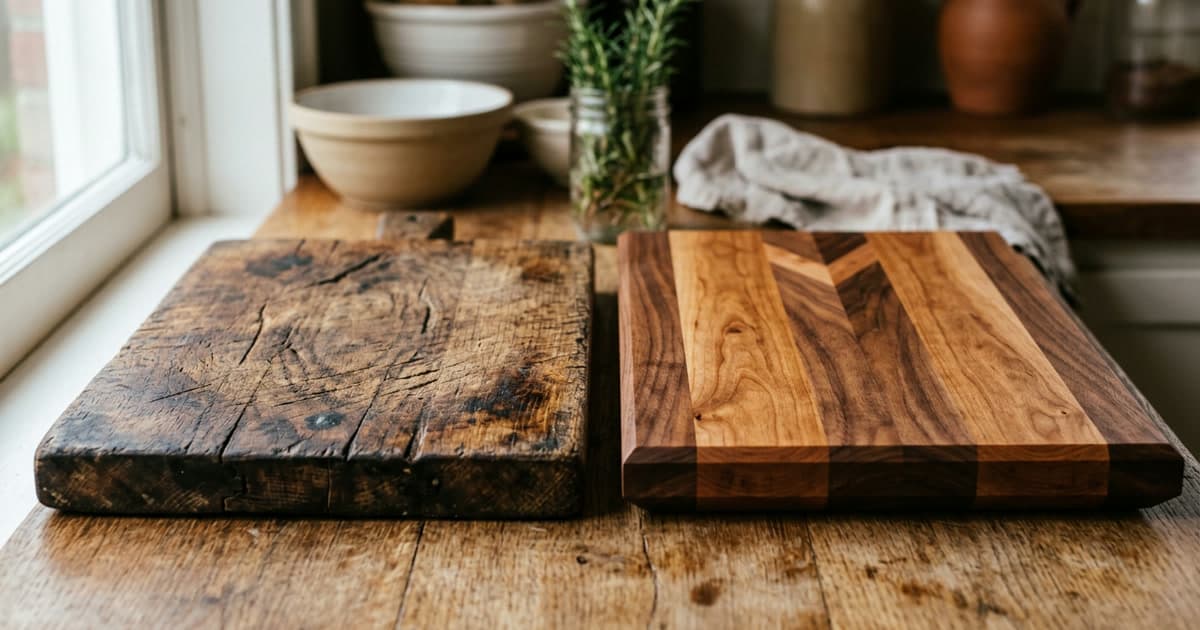
A good cutting board should last years. A great one should last decades. But no kitchen tool lasts forever, and there comes a point when even the most well-loved board needs to be retired. The challenge is knowing when that point has arrived.
Some signs of wear are cosmetic and easily fixed. Others are structural problems that make the board unsafe to use. At Schmidt Woodcraft, we want your boards to last as long as possible, which is why we are honest about what can be repaired and what cannot. Here is how to tell the difference.
Surface Knife Marks: Normal and Fixable
Let us start with what does not mean your board needs replacing. Surface knife marks are a completely normal part of a cutting board's life. Every time you use a knife on a wooden board, you create tiny impressions in the wood. Over months and years of use, these accumulate into a visible pattern of fine lines across the surface.
This is not damage. It is patina. Many home cooks come to appreciate the character that use marks give their board. It is a sign that the board is doing its job and doing it well.
Light knife marks do not affect food safety or the board's structural integrity. They can be sanded out during periodic maintenance if you prefer a smoother surface, but they do not need to be. A board covered in fine knife marks is a board that has been used, and that is exactly what it was made for.
Deep Grooves and Crevices: A Real Concern
There is an important difference between surface knife marks and deep grooves. Surface marks are shallow enough that a quick wash with soap and water cleans them completely. Deep grooves are cuts that go far enough into the wood to trap food particles, moisture, and bacteria in places that washing cannot reach.
If you run your fingernail across the cutting surface and it catches in grooves deep enough to feel like channels, the board has moved beyond normal wear. These deep cuts create a sanitation problem because no amount of surface cleaning can reach the bottom of a deep groove. Food residue accumulates there, moisture lingers, and bacteria can multiply in a space that your sponge and soap simply cannot access.
In some cases, deep grooves can be sanded out if the board is thick enough to remove that much material. But if the board is already thin, or if the grooves are numerous and spread across the entire surface, sanding may not be practical. For a walkthrough of the sanding and refinishing process, see our guide to restoring an old cutting board.
Cracks and Splits: The Most Serious Warning
Cracks are the most urgent sign that a cutting board needs to be replaced. Unlike knife marks, cracks are structural failures in the wood itself. They usually happen for one of two reasons: the board dried out excessively because it was not oiled regularly, or it was exposed to extreme moisture changes like being soaked in water or run through a dishwasher.
A crack in a cutting board is not just unsightly. It is a food safety hazard. Cracks penetrate deep into the wood, sometimes all the way through. They harbor bacteria, trap food particles, and retain moisture in ways that are impossible to clean. Even a small crack will get worse over time as the board continues to expand and contract with changes in humidity and temperature.
Small, shallow surface checks might be manageable if you catch them early and aggressively re-oil the board to rehydrate the wood. But any crack that runs more than a couple of inches, any crack you can fit a fingernail into, or any crack that goes through the full thickness of the board is a clear signal. The board has reached the end of its useful life.
Warping: When the Board Will Not Sit Flat
A cutting board that rocks on the counter or has a visible bow across its surface has warped. Warping happens when one side of the board absorbs or loses moisture at a different rate than the other side. The wetter side expands while the drier side stays the same, and the board bends.
Common causes include washing the board and laying it flat on the counter to dry (the top dries while the bottom stays wet), storing the board against a wall where one side is exposed to air and the other is not, or finishing only one side of the board so moisture enters unevenly.
Mild warping in a thick board can sometimes correct itself if you oil both sides thoroughly and store the board on its edge so air reaches both faces equally. Significant warping in a thin board is usually permanent. A warped board is unstable on the counter, which is a genuine safety concern when you are using sharp knives. If the board rocks when you press on it, it is time to move on.
Persistent Odors: A Deeper Problem
Wood naturally resists odor absorption, especially dense hardwoods like maple and walnut. But a board that has not been properly maintained, or one made from softer, more porous wood, can develop persistent odors over time.
The usual remedy is a salt and lemon scrub or a wipe-down with white vinegar. These treatments work well for surface-level odors caused by garlic, onions, or other strong foods. If these treatments resolve the smell, your board is fine. Carry on.
But if odors persist after cleaning and deodorizing, it means the source is deep within the wood where cleaning agents cannot reach. This typically happens when food particles or moisture have penetrated through cracks, deep grooves, or poorly sealed grain. At that point, the board has a bacterial problem that surface treatments will not solve, and replacement is the safest option.
How Long Should a Cutting Board Last
The lifespan of a cutting board depends almost entirely on two factors: what it is made from and how it is maintained.
A quality hardwood cutting board made from maple, walnut, or cherry and maintained with regular oiling can last 20 years or more. Some boards last even longer. We have seen well-maintained butcher blocks that have been in daily use for 30 or 40 years with nothing more than periodic oiling and the occasional light sanding.
A cheap board made from bamboo, thin laminated wood, or soft species like pine might last one to three years before developing the kinds of problems described above. Bamboo boards are especially prone to splintering and delamination because bamboo is processed with adhesives that can break down over time.
Plastic cutting boards have a different wear pattern. They develop deep knife grooves faster than wood because plastic does not have the self-healing fiber structure of hardwood. Most food safety guidelines recommend replacing plastic boards once the surface becomes heavily scored. In practice, that means every one to two years for a board used regularly.
When you compare these lifespans, the value proposition of a quality wooden board becomes clear. A board that costs three to four times more than a plastic or bamboo alternative but lasts ten to fifteen times longer is not an expensive purchase. It is an economical one. For a deeper comparison, read our post on wood versus plastic cutting boards.
Making Your Next Board Last
If your current board is showing signs that it is time for a replacement, the good news is that choosing the right replacement and maintaining it properly will give you decades of service before you face this decision again.
Here is what matters most for longevity. Choose a board made from dense, closed-grain hardwood. Maple, walnut, and cherry are the top choices for a reason. Make sure the board is thick enough to withstand years of use and occasional sanding. Oil the board regularly with food-grade mineral oil. Never soak it in water or put it in the dishwasher. Store it on its edge so air circulates around both faces. These simple habits prevent the cracking, warping, and odor problems that end a board's life prematurely.
Find a Board Built to Last
Replacing a cutting board does not have to happen often, and it should not. When you invest in a handcrafted board made from premium hardwoods, finished with food-safe oils and beeswax, and built with proper joinery, you are buying something that will serve your kitchen for decades to come.
Browse our collection of handcrafted cutting boards, each one built in our Jacksonville workshop from hard maple, walnut, and cherry. And if you have a specific size, style, or wood combination in mind, send us a custom order request. We will build a board that fits your kitchen and your cooking style perfectly.
Looking for the perfect cutting board?
Every board we make is built by hand in our Jacksonville, FL workshop using premium hardwoods. Browse our collection or request a custom piece.