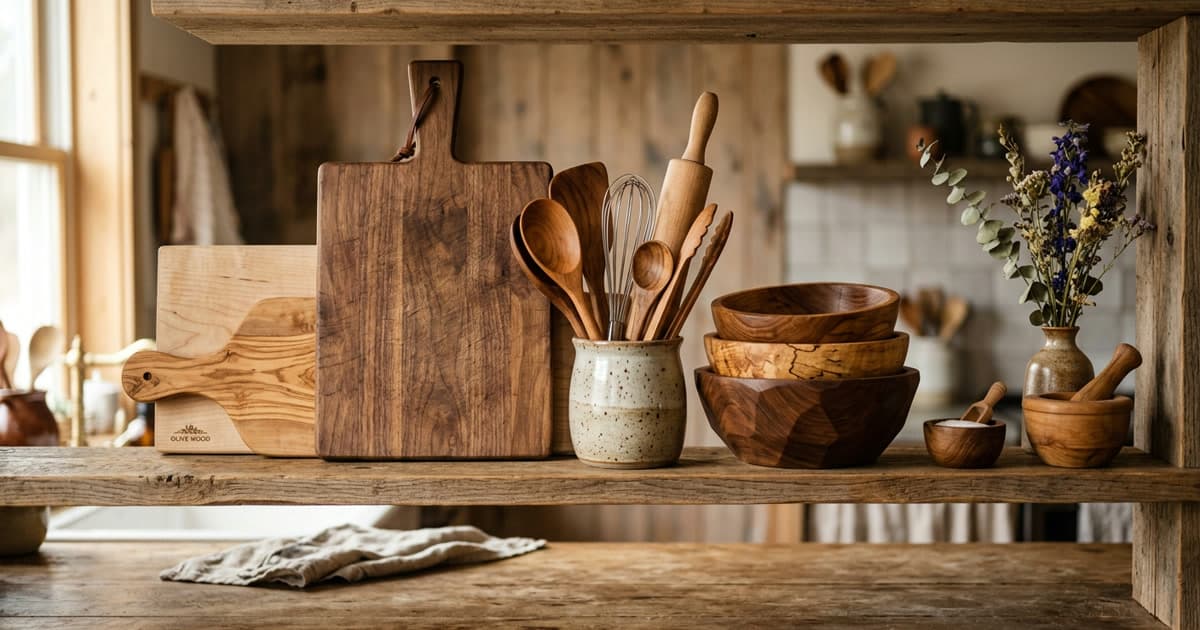
Walk into a well-designed kitchen and you will notice something. The best ones do not hide everything behind cabinet doors. They display a few carefully chosen items that are both useful and beautiful. A thick cutting board leaning against the backsplash. A wooden tray holding oils and salt on the counter. A set of handmade utensils standing in a ceramic crock near the stove. These pieces are working tools and decorative objects at the same time, and that dual purpose is exactly what makes a kitchen feel warm and lived in.
At Schmidt Woodcraft, most of what we build lives out on the counter rather than tucked away in a drawer. Our customers tell us that the moment they stop hiding their cutting board and start displaying it, their kitchen feels different. More intentional. More personal. Here is how to use wooden kitchen accessories as the decor your kitchen has been missing.
Why Wooden Pieces Work as Decor
There is a reason interior designers consistently recommend natural materials for kitchen spaces. Wood brings warmth and texture that manufactured materials cannot replicate. Every board, tray, and utensil has unique grain patterns, color variations, and subtle imperfections that give it character. A walnut cutting board does not look like a decoration. It looks like something with a story, something that belongs in a home rather than a showroom.
Wood also plays well with virtually every kitchen style. It complements the clean lines of a modern kitchen, adds richness to a traditional one, and feels right at home in farmhouse, transitional, and mid-century spaces. This versatility is hard to find in any other material. A stainless steel appliance only fits certain aesthetics. A piece of walnut fits all of them.
The other advantage is longevity. A handmade wooden piece does not just maintain its looks over time. It improves. The wood deepens in color as it ages. The surface develops a gentle patina from years of use and oiling. Unlike decorative items that fade, chip, or go out of style, a quality wooden kitchen piece becomes more beautiful the longer you own it.
Cutting Boards on Display
A cutting board is the single most impactful piece you can display in your kitchen. Lean a large board against the backsplash and it instantly anchors the counter with a focal point that is both functional and striking. The trick is choosing a board that is worth looking at. A handmade hardwood board with visible grain, rich color, and clean proportions stands on its own as a piece of art.
For display purposes, walnut is our most popular choice. Its deep chocolate tones and dramatic grain create visual interest that draws the eye without being loud. Cherry offers a warmer, reddish hue that brightens a space. Maple provides a lighter, cleaner look that works especially well in darker kitchens that need contrast.
You can display a single large board or lean two or three boards of different sizes and wood species together. Staggering them in height creates a layered look that adds depth to the counter. This works particularly well on a section of counter that does not have upper cabinets above it, giving the boards room to stand tall without looking cramped.
The best part is that your display board is always ready to use. Pull it down when you are cooking, put it back when you are done. It stores itself by being on display. If you are considering which board to feature, our guide on choosing the right cutting board size can help you pick one that fits both your cooking needs and your counter space.
Serving Trays as Counter Organizers
A wooden serving tray sitting on the counter is one of the simplest decorating moves you can make, and it solves a practical problem at the same time. Instead of olive oil, vinegar, salt, and pepper scattered randomly near the stove, place them on a tray. Suddenly those everyday items look curated and intentional rather than cluttered.
This approach works throughout the kitchen. A tray near the coffee maker corrals the sugar bowl, a small creamer, and your favorite mug into a tidy coffee station. A tray on the island holds a fruit bowl, a candle, and a stack of cloth napkins. The tray creates a visual boundary that turns loose items into a composed arrangement.
For counter use, a rectangular tray with low sides tends to look the most polished. It fits neatly against the backsplash and provides a clean frame for whatever you place on it. When guests arrive, lift the tray off the counter, load it with drinks or appetizers, and carry it to wherever people are gathered. That seamless transition from decor to function is what makes a serving tray one of the most versatile pieces you can own.
Utensils Worth Showing Off
Most kitchen utensils are designed to be invisible. They live in a drawer and come out when needed. Wooden utensils deserve better than that. A collection of handmade wooden spoons, spatulas, and tongs standing upright in a crock or jar near the stove creates a warm, inviting accent that tells everyone this is a kitchen where real cooking happens.
The key is choosing utensils that are genuinely well made. Mass-produced wooden utensils tend to look flat and uniform, which defeats the purpose of displaying them. Handmade pieces have variations in grain, shape, and finish that make each one distinct. When you group several together, those variations create visual richness that no matched set can achieve.
Mix wood species for added interest. A walnut spoon next to a cherry spatula next to a maple tong creates a range of tones from light to dark that is naturally beautiful. You do not need to coordinate them perfectly. The organic variation of different woods is the whole point. They look collected, not manufactured.
Wooden Bowls and Vessels
A large wooden bowl on the counter or kitchen table is a classic decorative element that also happens to be incredibly useful. Use it as a fruit bowl during the week, a salad bowl when hosting, or an empty centerpiece that looks complete all on its own. The curve and depth of a turned wooden bowl catches light in ways that flat surfaces cannot, creating a sculptural presence on the table.
Smaller wooden vessels work well as salt cellars, spice containers, or catch-alls for odds and ends near the kitchen entry. A hand-turned walnut salt cellar sitting open near the stove looks beautiful and keeps finishing salt within arm's reach while you cook. These small pieces add layers of warmth and texture that make a kitchen feel personal and well thought out.
The rule with wooden bowls and vessels as decor is the same as with every other piece: choose quality over quantity. One beautiful bowl does more for a space than five ordinary ones. The wood should be carefully finished, the proportions should feel balanced, and the piece should look like it was made with intention.
Creating a Cohesive Look
When you display multiple wooden pieces in the same kitchen, it helps to think about how they relate to each other. You do not need everything to match. In fact, matching too precisely can look rigid and staged. But some visual continuity ties the space together.
The easiest approach is to stick with two or three wood species and repeat them throughout the kitchen. Walnut and maple is a classic pairing. The contrast between dark and light creates energy without clashing. Cherry and walnut share enough warmth to feel harmonious while still being distinct from each other.
Distribute your wooden pieces around the kitchen rather than clustering them all in one spot. A cutting board on one counter, a tray on the island, utensils by the stove. This creates a rhythm that draws the eye through the space and makes the entire kitchen feel cohesive rather than decorated in one corner and bare everywhere else.
Pay attention to scale as well. A mix of large, medium, and small wooden pieces creates visual variety. A large cutting board, a medium tray, and a small utensil crock provide different sizes and shapes that keep things interesting. If everything is the same scale, the arrangement feels flat. For more ideas on pairing pieces for entertaining and daily use, our post on essential wooden kitchen pieces for hosting covers the items that work hardest in a well-equipped kitchen.
Caring for Pieces on Display
Kitchen pieces that live on the counter need a little more attention than those stored in cabinets, simply because they are exposed to light and air all day. The good news is that the care is minimal and actually keeps the pieces looking better.
Oil your displayed boards and trays every few weeks with food-safe mineral oil. The oil keeps the wood hydrated and brings out the depth of the grain, which is exactly what you want for pieces that are on show. A freshly oiled cutting board has a rich, warm glow that no amount of decorating can fake. It looks alive.
Keep displayed pieces away from direct sunlight if possible. Prolonged UV exposure can fade wood over time, particularly cherry, which is naturally photosensitive. If your kitchen gets strong afternoon sun on one section of counter, position your wooden pieces elsewhere or rotate them occasionally so they age evenly.
Wipe displayed pieces down regularly even when you have not used them for food prep. Kitchen air carries grease and moisture that settles on surfaces. A quick wipe with a dry cloth keeps your boards and trays looking sharp between uses. For a full breakdown of wood care best practices, visit our guide on how to care for your cutting board.
Functional Beauty in Every Piece
The best kitchen decor is the kind you actually use. A wooden cutting board that leans against the backsplash all morning and comes down for dinner prep. A serving tray that organizes your countertop on Tuesday and carries cocktails on Saturday. Utensils that look beautiful in a crock and feel even better in your hand. These are not decorations pretending to be useful or tools pretending to be decorative. They are genuinely both.
Every piece we build at Schmidt Woodcraft is made to be displayed and used with equal pride. We select wood for its grain character and beauty, and we finish each piece by hand to bring out its natural warmth. Browse our collection to find pieces that will make your kitchen look as good as it functions, or reach out about a custom piece designed to fit your space perfectly.
Looking for the perfect cutting board?
Every board we make is built by hand in our Jacksonville, FL workshop using premium hardwoods. Browse our collection or request a custom piece.