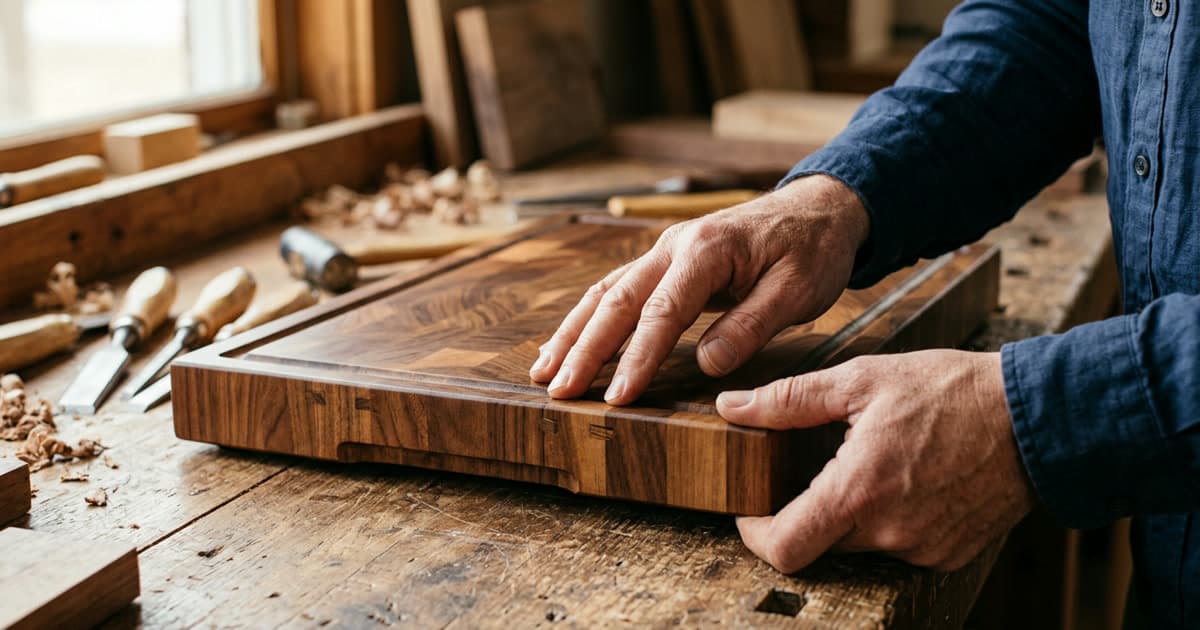
You do not need to be a woodworker to recognize quality woodwork. You just need to know what to look for. Whether you are shopping for a cutting board, a serving tray, or a custom piece for your home, a few simple checks will tell you whether you are looking at something built to last or something that will disappoint you within a year.
At Schmidt Woodcraft, we build every piece by hand in our Jacksonville, FL workshop. We have strong opinions about what separates genuine quality from the rest, and we are happy to share them. Here is a practical guide to evaluating woodwork, even if you have never picked up a chisel in your life.
Start with the Joints
Joints are the single most revealing indicator of quality in any piece of woodwork. They are where two pieces of wood meet, and they tell you almost everything about the care that went into building the piece.
In quality woodwork, joints are tight. Run your fingertip along any seam where two pieces of wood come together. You should feel a smooth, continuous surface. There should be no gap, no ridge, and no noticeable transition from one piece to the next. A well-executed joint feels like a single piece of wood, even though it is not.
In cheaper products, joints often have visible gaps filled with putty or excess glue. You might see thin lines of dried adhesive squeezed out along the seam, or slight misalignments where one board sits a fraction higher than the one next to it. These are signs of rushed assembly. The pieces were cut without precision, clamped without patience, or both.
On a cutting board or butcher block, check the end grain joints especially carefully. End grain construction involves dozens of small blocks glued together, and every single joint needs to be solid. If you see gaps between blocks or glue lines that are inconsistent in width, the board was not given the time and attention it deserves.
Feel the Finish
The finish on a piece of woodwork is not just about appearance. It is a protective layer that determines how the piece will hold up over years of use. And like joints, the finish reveals a lot about the builder's standards.
Pick up the piece and run your hands over every surface, including the bottom. Quality woodwork is finished on all sides, not just the top. The surface should feel uniformly smooth, without rough patches, bumps, or areas where the finish was applied unevenly. There should be no raised grain, no sanding scratches visible under the finish, and no drips or pooling.
On a well-finished piece, the wood feels almost silky. That smoothness comes from sanding through progressively finer grits before applying the finish. Skipping grits or rushing the sanding process leaves a surface that looks fine from a distance but feels rough under your fingertips. Trust your hands. They are more sensitive than your eyes.
Also pay attention to the edges and corners. Quality pieces have edges that are gently rounded or chamfered. This is not just aesthetic. Sharp edges chip more easily, collect less finish, and are uncomfortable to handle. A craftsperson who takes the time to soften every edge is someone who cares about the details.
Look at the Grain
The way wood grain is oriented in a piece tells you whether the builder was thoughtful about material selection or just cutting boards from whatever lumber happened to be on hand.
In a quality cutting board, the grain runs consistently across the piece. If it is an edge grain board, you should see long, straight grain lines running from end to end. If it is end grain, the block pattern should be uniform and intentional. The grain direction matters because it affects how the wood responds to moisture, temperature changes, and mechanical stress. Proper grain orientation means the piece will stay flat and stable for years. Poor grain orientation leads to warping, cupping, and cracking.
On any piece of woodwork, look for evidence that the builder chose specific boards for specific purposes. The most visually striking face of the wood should be oriented where you will see it most. Grain patterns should flow naturally across the piece rather than clashing or running in conflicting directions. This kind of intentional material selection is a hallmark of handcrafted quality, and it is one of the things that factory production simply cannot replicate at scale.
Consider the Wood Species
Not all wood is created equal, and the species used in a piece of woodwork has a direct impact on its performance and longevity. Quality kitchen woodwork is built from proven hardwood species. For cutting boards and kitchen items, that means woods like hard maple, walnut, and cherry.
Hard maple is one of the densest domestic hardwoods available. It resists knife marks, does not absorb odors, and has natural antimicrobial properties. Walnut is slightly softer but incredibly durable, with a rich color and beautiful grain that darkens with age. Cherry occupies a lovely middle ground and develops a warm, deep patina over years of use. For a detailed comparison of these three species, see our guide to cherry, maple, and walnut.
Cheaper products often use bamboo, rubberwood, acacia, or unspecified "hardwood." These materials are not necessarily bad, but they do not perform at the same level. Bamboo is technically a grass and is processed with heavy adhesives that can break down over time. Rubberwood is soft and prone to knife marks. Acacia varies enormously in quality depending on the specific species and growing conditions. If a product does not clearly state what wood it is made from, that is usually a sign that the builder is not proud enough of the material to name it.
Pick It Up: Weight Tells a Story
Weight is one of the most underappreciated indicators of quality in woodwork. Dense hardwood is heavy. There is no getting around it. A quality cutting board made from hard maple or walnut has a satisfying heft that you notice the moment you pick it up.
That weight comes from density, and density is what makes wood durable. Dense wood resists knife marks. It does not dent easily. It holds up to years of daily use without wearing down. When you pick up a cutting board and it feels surprisingly light for its size, it is likely made from a less dense species or was milled thin to save on material.
Thickness matters too. A quality edge grain cutting board is typically at least three-quarters of an inch thick, and many are a full inch or more. End grain boards are usually an inch and a half or thicker. Thin boards feel flimsy, flex under pressure, and are more prone to warping because there is less material to resist the forces of moisture and temperature changes.
This does not mean heavier is always better. A piece should feel balanced and proportional. But if you are comparing two cutting boards of similar size and one weighs noticeably more, the heavier board is very likely the better-made product.
Red Flags to Watch For
Beyond knowing what quality looks like, it helps to know the warning signs of poor craftsmanship. Here are the most common red flags we see in mass-produced and low-quality woodwork:
- Visible glue residue. Dried glue along joints means the builder did not clean up after assembly. More importantly, it suggests the joints were not tight enough and excess glue was used to compensate.
- Inconsistent coloring or staining. If a piece looks like it was stained to disguise imperfections or to make cheap wood look like something more expensive, proceed with caution. Quality wood does not need to be disguised.
- Rough or unfinished undersides. If the bottom of a cutting board or the back of a shelf is left rough and unfinished, the builder was cutting corners. Moisture enters unfinished surfaces and causes warping, cracking, and premature aging.
- Plastic or silicone feet glued on. Quality boards may have feet, but they should be integrated thoughtfully. Cheap adhesive feet fall off within months and leave sticky residue behind.
- Vague product descriptions. Phrases like "natural wood," "eco-friendly material," or "premium hardwood" without naming the actual species are marketing language designed to obscure the truth about what you are buying.
- Uniform perfection across many units. This sounds counterintuitive, but if every single board in a product listing looks identical, you are probably looking at factory production. Real wood varies naturally from piece to piece, and a handmade producer will show that variation honestly rather than hiding it.
The Price Question
Quality woodwork costs more than mass-produced alternatives. This is simply a fact of materials and labor. Premium hardwoods cost more than commodity lumber. Hand-selecting boards for grain and color takes more time than feeding lumber through a factory line. Careful joinery, thorough sanding, and proper finishing all take hours that a factory does not invest.
But the price difference makes sense when you consider the lifespan. A well-made hardwood cutting board will serve you for 20 years or more. A cheap board might last two years before it warps, cracks, or develops deep grooves that are impossible to clean. Over a decade, the handmade board is not just the better product. It is often the better value. For a deeper look at this comparison, read our post on handcrafted versus mass-produced kitchenware.
Trust Your Senses
The best advice we can give is simple: trust what your hands and eyes tell you. Pick the piece up. Feel the surface. Look at the joints up close. Check the bottom and the edges. Smell the wood. Quality woodwork engages your senses in a way that mass-produced products never do. It feels substantial. It looks intentional. It even smells like real wood rather than chemical finishes.
You do not need expertise to appreciate these things. You just need to pay attention. And once you start noticing the difference, you will never want to go back to settling for less.
If you are ready to experience what quality woodwork feels like in your own kitchen, browse our collection of handcrafted cutting boards, serving trays, and kitchen pieces. Every item is built from premium hardwoods in our Jacksonville workshop. And if you have something specific in mind, submit a custom order request and we will build it exactly the way you want it.
Looking for the perfect cutting board?
Every board we make is built by hand in our Jacksonville, FL workshop using premium hardwoods. Browse our collection or request a custom piece.