There is a reason your grandmother's wooden spoon outlasted every kitchen gadget that came after it. It was made by someone who cared about the wood, the shape, and the purpose it would serve. That approach to making things has not disappeared. It has just become harder to find in a world dominated by mass production.
At Schmidt Woodcraft, we build kitchen pieces by hand in our Jacksonville, FL workshop. We chose this path not because it is easier or faster, but because the results are genuinely different from what a factory can produce. Here is what actually separates handcrafted kitchenware from mass-produced alternatives, and why that difference matters in your kitchen.
How Mass Production Cuts Corners
Mass-produced kitchenware is engineered for one thing above all else: cost efficiency. Every decision in the manufacturing process is driven by the need to produce the most units at the lowest cost. That is not inherently wrong, but it does have consequences for the product you end up with.
Wood selection is the first place you see it. A factory processing thousands of cutting boards per week cannot hand-pick every piece of lumber. They buy in bulk, and the quality varies. You might get a board with tight, straight grain, or you might get one with knots, sapwood, or inconsistent moisture content. The factory cannot afford to be selective because selectivity slows down production.
Joinery is another area where shortcuts show up. Mass-produced boards are glued quickly and clamped briefly. In a handmade shop, glue-ups are left under pressure for hours, sometimes overnight, to ensure the bond is complete and the joints will not fail under years of use. A factory clamping a board for 20 minutes gets a joint that holds, but it is not the same.
Finishing tells the story too. Factory boards are often run through a sanding machine that hits the major grits and moves on. Then a finish is sprayed on in a single coat. The result is serviceable but far from the smooth, saturated surface you get from hand sanding through progressive grits and applying multiple coats of oil with time to absorb between each one.
Material Quality Makes the Difference
The wood species used in a kitchen piece determines how it performs for years to come. Handmade producers can be particular about what wood goes into each piece. We use hard maple, walnut, and cherry because these species have proven themselves in kitchens for generations.
Hard maple is one of the densest domestic hardwoods. It resists knife marks, does not absorb flavors, and has a tight grain that naturally inhibits bacteria. Walnut brings warmth and beauty along with antimicrobial properties. Cherry is a graceful middle ground that develops a stunning patina over years of use.
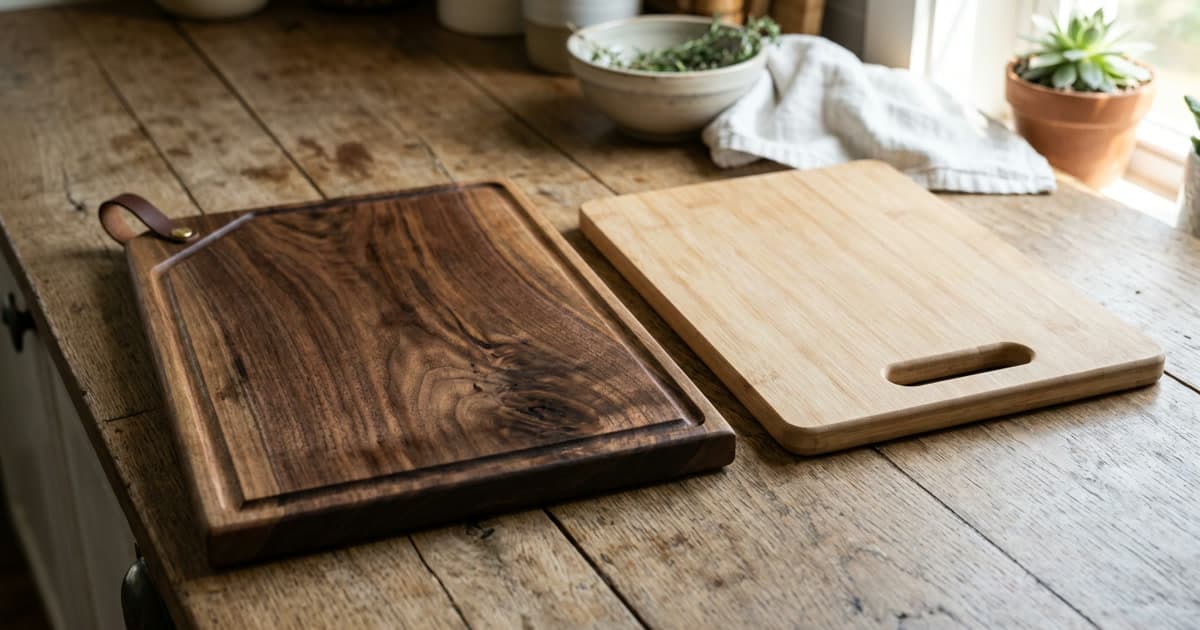
Mass-produced kitchenware often substitutes these premium hardwoods with cheaper alternatives. Rubberwood, acacia, and bamboo are popular in factory production because they are inexpensive and widely available. They work, but they do not perform at the same level. Bamboo, despite its reputation as a durable material, is actually a grass. It is processed with heavy adhesives and can splinter over time. Acacia varies wildly in density depending on the specific species and where it was grown.
When you pick up a handmade cutting board made from hard maple and hold it next to a factory-made bamboo board, the difference is obvious before you even use them. The weight, the density, the grain. You can feel the quality.
Craftsmanship You Can See and Feel
Handcrafted kitchenware carries details that machines simply cannot replicate. The edges of a hand-finished board have a soft, rounded profile that feels natural in your hands. The surface is sanded to a smoothness that you notice the first time you run your fingers across it. The grain pattern is selected intentionally, with the most beautiful face oriented upward.
These are not vanity details. They affect how the piece functions in your kitchen. Rounded edges are more comfortable to grip when you are carrying a heavy board to the table. A properly sanded surface resists staining and is easier to clean. Thoughtful grain orientation means the wood expands and contracts predictably with changes in humidity, reducing the risk of warping or cracking.
There is also the matter of proportion. A handmade piece is designed with balance in mind. The thickness relates to the width. The weight feels right for the size. These proportions come from experience and intention, not from an algorithm optimizing material usage.
Built to Last Versus Built to Replace
Here is a fundamental difference in philosophy. Mass-produced kitchenware is built with the assumption that you will replace it. The manufacturer knows that a thin bamboo cutting board will warp within a year or two. They are counting on you to buy another one. The entire business model depends on repeat purchases driven by product failure.
Handcrafted kitchenware is built with the opposite assumption. We want the board you buy from us today to be the board your family uses for the next two decades. That means using thicker stock, stronger joinery, better wood, and a finish that protects the surface through years of daily use.
This difference in philosophy affects every decision in the building process. We choose waterproof, food-safe glue that costs more than the standard adhesive a factory might use. We dry and acclimate our wood properly, even though it means material sits in our shop for weeks before we can use it. We sand to a higher grit because a smoother surface lasts longer and is easier to maintain.
The Environmental Case
There is an environmental dimension to this that does not get talked about enough. A cutting board that lasts 20 years generates far less waste than one that gets replaced every two years. Over two decades, you might go through eight to ten factory-made boards. Each one ends up in a landfill. Each one required raw materials, energy, shipping, and packaging.
One well-made board, maintained with a coat of mineral oil every now and then, serves you for the same 20 years with zero waste. And at the end of its very long life, a solid hardwood board biodegrades naturally. The bamboo board laminated with formaldehyde-based adhesives does not break down nearly as cleanly.
Buying handmade is not just a quality decision. It is a sustainability decision. Fewer products consumed, less waste generated, and less demand for the industrial processes that produce cheap goods at environmental cost.
What Handmade Actually Means
It is worth clarifying what we mean by "handmade" because the term gets used loosely. At Schmidt Woodcraft, handmade means that a person selected the wood, designed the piece, cut and milled the lumber, glued and clamped the joints, sanded the surfaces, applied the finish, and inspected the final product. Machines are part of the process because we use table saws, planers, and sanders. But every machine is guided by a person making decisions based on the specific piece of wood in front of them.
A factory runs the same program for every board regardless of the individual characteristics of each piece of wood. A craftsperson adjusts. They notice a beautiful grain pattern and orient it for maximum visual impact. They feel a rough spot and give it extra attention. They test the finish with their hands and add another coat if it needs it. That responsiveness is what handmade really means.
Investing in Your Kitchen
Your kitchen tools shape your daily experience more than almost anything else in your home. You use them every morning and every evening. They are the things your hands touch most often. Investing in handcrafted kitchenware is not about luxury. It is about choosing tools that perform better, last longer, and make the everyday act of preparing food a little more satisfying.
If you have been relying on mass-produced kitchen pieces and want to experience the difference that handmade quality makes, explore our collection. Every piece is built in our Jacksonville workshop from premium hardwoods. And if you have something specific in mind, submit a custom order request and we will build it for you.
Looking for the perfect cutting board?
Every board we make is built by hand in our Jacksonville, FL workshop using premium hardwoods. Browse our collection or request a custom piece.