Wood is a living material. Long after a tree has been felled, milled, and shaped into a cutting board or serving tray, the wood continues to respond to the environment around it. It absorbs moisture from humid air and releases it in dry conditions. It expands in summer and contracts in winter. These movements are subtle, but over the course of the seasons, they determine whether your wooden kitchen items stay beautiful or develop problems.
Understanding how humidity affects wood is the single most useful thing you can know about caring for your kitchen pieces. Once you understand the relationship, the maintenance practically takes care of itself. Here in Jacksonville, FL, we deal with some of the most extreme humidity swings in the country, so we have learned these lessons firsthand.
How Humidity Affects Wood
Wood is hygroscopic, which means it absorbs and releases moisture from the surrounding air until it reaches equilibrium with its environment. When the air is humid, wood absorbs moisture and swells slightly. When the air is dry, wood releases moisture and shrinks. This process never stops. It is happening to every piece of wood in your home right now.
The amount of movement depends on the wood species, the grain orientation, and the magnitude of the humidity change. Dense hardwoods like maple and walnut move less than softer species because their tight cell structure absorbs and releases moisture more slowly. Proper grain orientation in a well-made cutting board minimizes movement by ensuring the wood expands in predictable directions. But all wood moves to some degree, and the bigger the swing in humidity, the more it moves.
Problems arise when the change is too fast or too extreme. Rapid drying causes the outer layers of wood to shrink while the interior is still moisture-rich. This creates internal stress that the wood relieves by cracking. Rapid swelling can stress glue joints as adjacent pieces of wood expand at slightly different rates. Most of the cracking, warping, and joint failure we see in cutting boards is caused not by use or age, but by humidity.
Summer: The Humid Months
If you live in a humid climate like Florida, the Southeast, or the Gulf Coast, summer brings moisture levels that can stay above 70 or 80 percent for weeks at a time. Your kitchen may be somewhat controlled by air conditioning, but every time you open the door, cook with steam, or run the dishwasher, humid air moves through the space.
The good news is that humidity is generally easier on wood than dryness. Wood that absorbs a bit of extra moisture swells slightly, but the fibers remain flexible and intact. You might notice that your cutting board feels slightly heavier in the summer, or that the surface has a subtly different texture. These are normal responses and they are not harmful.
The risk in humid months is not too much moisture in the wood itself. It is moisture sitting on the surface for too long. A cutting board that is left wet on the counter, stored in a damp cabinet, or placed near a sink where it gets splashed regularly can develop surface mold or water stains. In extreme cases, prolonged surface moisture can cause the wood fibers to swell and lift, creating a rough texture that requires sanding to fix.
During humid months, focus on keeping your boards dry on the surface. Towel-dry after every wash. Store boards on their edge in a well-ventilated area, not flat in a dark cabinet. If you notice any mustiness in your storage area, improve air circulation by propping the cabinet door open or moving the boards to a drier location.
You can ease up on oiling frequency during the summer because the ambient moisture helps keep the wood hydrated naturally. If you normally oil once a month, you might extend that to every six weeks in the summer without any issues.
Winter: The Dry Season
Winter is when wood takes the most damage, and it catches many people off guard. Even in Florida, winter months bring lower humidity levels. In northern climates, the combination of cold outdoor air and heated indoor air can drive interior humidity below 20 percent. That is desert-level dryness, and wood does not handle it well.
When humidity drops, wood loses moisture and contracts. If it loses moisture too quickly, the outer surface shrinks faster than the interior, which creates the internal tension that leads to surface cracks. These cracks often appear suddenly. You might oil your board in November and find a crack in January, seemingly out of nowhere. What happened was not sudden at all. The board slowly dried out over weeks as the air in your kitchen got progressively drier.
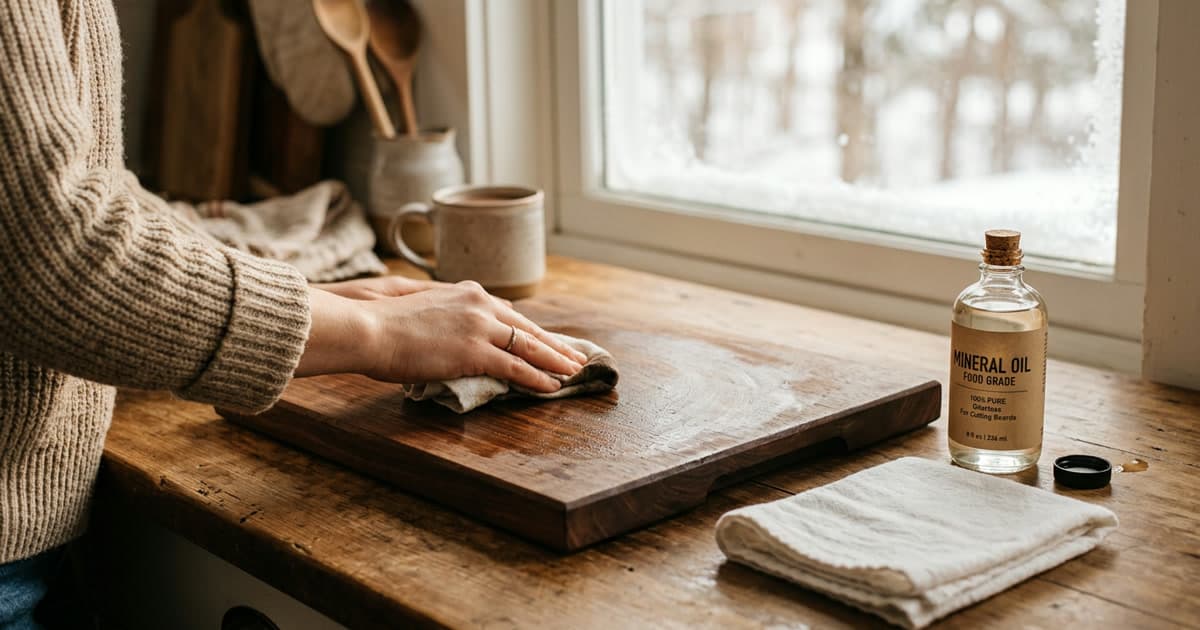
Winter is when you need to increase your oiling frequency. If you normally oil once a month, switch to every two to three weeks during the dry months. The oil does not add moisture to the wood directly, but it fills the spaces between wood fibers and slows down moisture loss. Think of it as a barrier that gives the wood time to adjust to changing conditions gradually rather than all at once.
If you run a wood stove or a fireplace, or if your heating system is particularly aggressive, your kitchen air may be even drier than the general indoor environment. Consider placing your wooden kitchen items away from direct heat sources. A cutting board stored next to the stove or on top of a radiator will dry out far faster than one stored on a shelf across the room.
The Transitional Seasons
Spring and fall are when the most dramatic humidity swings occur. A week of cool, dry weather followed by a warm, humid stretch can create rapid changes that stress wood more than a consistently dry or consistently humid environment.
During these transitional periods, keep an eye on your wooden items and oil them proactively. If you notice the surface starting to look pale or feel rough, that is the wood telling you it needs oil. Do not wait for your regular schedule. A quick coat of mineral oil during a transitional week can prevent a crack that would appear two weeks later. For a complete guide to oiling schedules and techniques, visit our wood care guide.
The water test works especially well during transition seasons. Sprinkle a few drops of water on the board. If it beads up, the finish is intact and the wood is well protected. If it absorbs within a few seconds, oil right away.
Storing Your Boards Properly
How you store your wooden kitchen items has a bigger impact on their longevity than most people realize. The ideal storage spot has three qualities: consistent temperature, moderate air circulation, and protection from direct sun or heat.
Always store cutting boards on their edge rather than flat. When a board lies flat on a counter or shelf, the bottom face cannot breathe. Moisture accumulates on the contact side while the top dries freely. This uneven drying is one of the most common causes of warping. Standing the board on its edge allows air to reach both faces equally, which keeps the moisture content even throughout the wood.
Avoid storing boards directly next to the stove, near a heating vent, or in a window that gets strong afternoon sun. These heat sources accelerate drying on one side of the board and can cause surface cracks in a matter of weeks. A cabinet or shelf that stays at a relatively stable temperature is ideal.
If you display your boards on the counter or mounted on the wall, which many of our customers do because the boards are beautiful, just be mindful of what is nearby. A board leaning against a tile backsplash that gets afternoon sun will dry out on the back while the front stays shaded. Rotate displayed boards occasionally so both sides get similar exposure.
Climate-Specific Tips for Florida
Since our workshop is in Jacksonville and many of our customers are in Florida, here are a few tips specific to our climate.
Florida summers are relentlessly humid. Your biggest challenge from June through September is keeping surfaces dry, not keeping wood hydrated. Do not skip the towel-drying step after washing, even though it might feel unnecessary when the air itself is wet. Surface moisture in a warm environment is a recipe for mold, and mold on a cutting board is a problem you want to avoid entirely.
Florida winters are mild but noticeably drier than summer, especially inland. January and February are the months when we see the most customer inquiries about cracks and dry surfaces. A few extra coats of mineral oil during these months will prevent most issues. If you are heading north for the winter and leaving your boards in a house with the air conditioning set to a holding temperature, oil them well before you leave and store them on their edge.
Air conditioning is the silent factor. We run our AC for eight or nine months of the year in Florida, and air conditioning removes moisture from the indoor air. Your kitchen may feel comfortable at 74 degrees, but the humidity inside your air-conditioned home can be significantly lower than the tropical air outside. Your boards are living in the indoor climate, not the outdoor one. Keep that in mind when deciding how often to oil.
A Little Attention Goes a Long Way
Seasonal wood care is not complicated. It comes down to one simple principle: keep the moisture content of your wood stable by oiling more when the air is dry and keeping surfaces dry when the air is humid. Do that, and your cutting boards, serving trays, and kitchen pieces will stay flat, crack-free, and beautiful for years regardless of what the weather does outside.
For a complete guide to maintaining your wooden kitchen items throughout the year, including cleaning, oiling, and dealing with stains, read our post on how to care for your wooden cutting board. And if you are looking for boards built to handle the demands of your climate, explore our collection of handcrafted kitchen pieces made from dense, stable hardwoods that are selected to perform beautifully for decades.
Looking for the perfect cutting board?
Every board we make is built by hand in our Jacksonville, FL workshop using premium hardwoods. Browse our collection or request a custom piece.