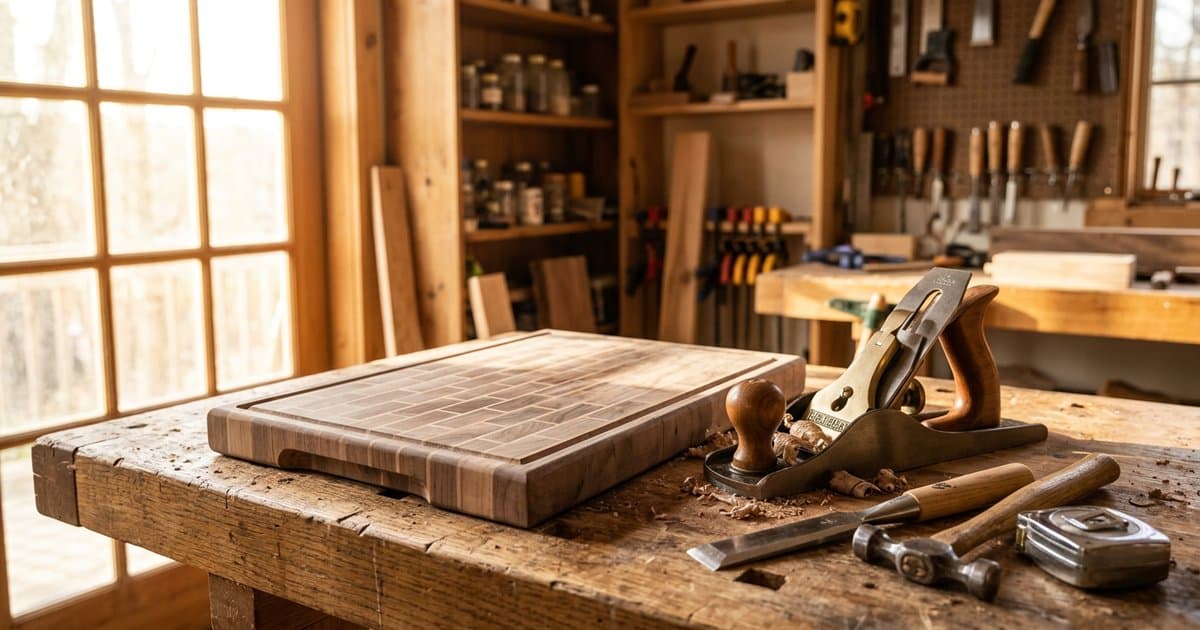
Every workshop has a way of doing things. Some of it is learned from books and mentors, some of it develops through years of trial and error, and some of it comes from a gut-level conviction about what good work looks like. At Schmidt Woodcraft, our philosophy has taken shape over a long time, and it guides every decision we make, from the lumber we buy to the finish we apply to the way we treat our customers.
We thought it was worth putting that philosophy into words. Not because it makes us special, but because we think the people who buy our work deserve to know what is behind it. When you bring one of our pieces into your home, you are getting more than a cutting board or a serving tray. You are getting something built on a set of principles that we take seriously.
Build for the Long Haul
The single most important principle in our workshop is longevity. We build things to last. Not to last until the next kitchen remodel or until the finish wears off. We build with the intention that the piece will still be in service ten, twenty, even thirty years from now.
That principle affects everything downstream. It is why we use hardwoods like walnut, maple, and cherry instead of cheaper softwoods or composites. It is why we apply multiple coats of food-safe finish instead of a quick spray-and-ship. It is why we take the time to let glue joints cure fully rather than pulling pieces out of clamps early to move on to the next order.
There is something deeply satisfying about knowing that the board you built today will still be on someone's counter years from now, seasoned by use and still performing beautifully. That is the kind of work we want to put into the world. Not disposable products that end up in a landfill, but durable pieces that become part of the daily rhythm of someone's kitchen.
Our customers tell us about it, too. We hear from people who bought a board from us years ago and still use it every day. That kind of feedback is worth more than any marketing metric. It means the philosophy is working.
Respect the Material
Wood is not a blank canvas. It has grain, character, history, and opinions about how it wants to behave. One of the most important things we have learned is to work with the wood rather than against it. That means understanding each species, reading the grain before we cut, and making design decisions that honor the natural properties of the material.
Walnut wants to show off its rich, chocolate-brown tones and its swirling grain. So we design pieces that give it room to do that. Maple is tight-grained and pale, with a clean, quiet beauty. We let maple be maple rather than trying to stain it into something it is not. Cherry starts light and deepens to a warm amber over the years. We choose finishes that let that natural aging process happen rather than locking in the color on day one.
Respecting the material also means being honest about its limitations. Wood moves. It expands when it absorbs moisture and contracts when it dries out. A responsible builder designs for that movement rather than ignoring it. We orient our grain carefully, use construction methods that allow for seasonal movement, and educate our customers on proper care so the wood can do its thing without causing problems.
When you fight the wood, you lose. When you respect it, you end up with something that looks natural, performs well, and lasts.
Choose Materials That Make Sense
Sustainability is a word that gets thrown around a lot, and we are wary of using it loosely. But the reality is that our material choices have consequences, and we think about those consequences seriously.
We source our hardwoods from domestic suppliers who practice responsible forestry. The walnut, maple, and cherry we use come from managed forests in the eastern United States, where trees are harvested selectively and replanted. These are not old-growth forests being clear-cut. They are working woodlands managed for long-term productivity.
We also minimize waste in our shop. Offcuts from larger projects become coasters, small serving boards, or practice pieces. Sawdust goes to local gardeners for composting. We plan our cuts to get the most out of every board foot of lumber, because wasting good wood is wasteful of both the resource and the money we spent on it.
The most sustainable product, though, is one that does not need to be replaced. A cutting board that serves your family for two decades is inherently more sustainable than a cheap board that gets tossed every couple of years. Longevity is the most honest form of sustainability, and it circles back to the first principle: build it to last.
The Hands Matter
We use machines in our workshop. Table saws, planers, routers, sanders. Anyone who claims to build without them is either working on a very small scale or not being entirely truthful. But the machines are tools guided by hands and eyes and judgment. The decisions that matter, what wood to use, how to orient the grain, when the surface is smooth enough, whether the finish looks right, those are all made by a person standing at the bench.
There is a knowledge that lives in the hands after years of working wood. You can feel the difference between a surface sanded to 220 grit and one taken to 400. You learn to read the sound of the planer and know whether it is cutting cleanly or tearing the grain. You develop an eye for color and figure that tells you which face of a board should be the show face.
That kind of knowledge does not translate into a computer program or a factory setting. It is earned through repetition, mistakes, and the thousands of small adjustments that add up over years of practice. It is why a handmade piece feels different from a machine-made one even when you cannot immediately point to the specific difference. The care is in there, woven into every surface.
Stand Behind Every Piece
Our name is on everything that leaves this workshop. Not a corporate logo designed by a marketing department, but our actual name. That is a powerful motivator to get things right.
When a customer buys a piece from us, they are entering into a relationship, not completing a transaction. We want to know how the piece performs in their kitchen. We want to hear if something is not right. And if there is ever an issue, we want to fix it, no arguments, no fine print, no passing the blame to a shipping company or a supplier.
Standing behind your work means more than offering a refund policy. It means being genuinely invested in the outcome. We care whether the board we built is making someone's cooking experience better. We care whether the serving tray we crafted is the piece they reach for when friends come over. That investment in the outcome is what separates a craftsperson from a manufacturer.
It is also why we keep our operation small and personal. We know our customers. Many of them come back for second and third pieces, or send us referrals. That repeat trust is the best measure of whether our philosophy is working in practice, not just in theory.
Tradition and Evolution
Woodworking is one of the oldest crafts in human history. The basic principles of joinery, finishing, and design have been refined over centuries. We see ourselves as part of that long tradition, learning from the craftspeople who came before us and applying their lessons to the work we do today.
But tradition does not mean standing still. We are always learning, testing new finishes, experimenting with wood combinations, and refining our processes based on customer feedback and our own experience. The cutting boards we build today are better than the ones we built five years ago, and the ones we build five years from now will be better still.
What does not change is the core commitment to quality and care. The specific techniques evolve, but the underlying philosophy stays the same. Build it right, build it to last, and take pride in the work. Those principles are as relevant now as they were when the first woodworker picked up a chisel.
Here in Jacksonville, we have built a workshop that reflects these values. It is not fancy, but it is well equipped and well organized. Every tool has its place. Every process has been thought through. The environment in the shop reflects the mindset we bring to the work, and we think that shows in the finished product.
Why It Matters to You
You might be wondering why any of this matters if you just need a cutting board. It is a fair question. The answer is that philosophy shows up in the product whether you think about it or not.
A board built with longevity in mind will still be solid and beautiful after years of daily use. A board built with respect for the material will age gracefully, developing character rather than deteriorating. A board built by hands that care will have a smoothness, a balance, and a presence that you notice every time you pick it up.
These are not things you can see in a product photo. They are things you discover through use, through the daily experience of preparing food on a surface that feels right. That feeling is the product of a philosophy applied consistently over every stage of the building process. It is what we work toward with every piece that leaves our shop.
Join Us in Building Something That Lasts
We are proud of the work we do and the principles that guide it. If our philosophy resonates with you, we would love to put a piece of our work in your kitchen. Every item in our collection is built right here in our Jacksonville workshop with the care and attention we have described here.
And if you have something specific in mind, something that fits your kitchen, your cooking style, and your taste, send us a custom order request. We will bring the same philosophy to your project and build something you will be proud to use for years to come.
Looking for the perfect cutting board?
Every board we make is built by hand in our Jacksonville, FL workshop using premium hardwoods. Browse our collection or request a custom piece.