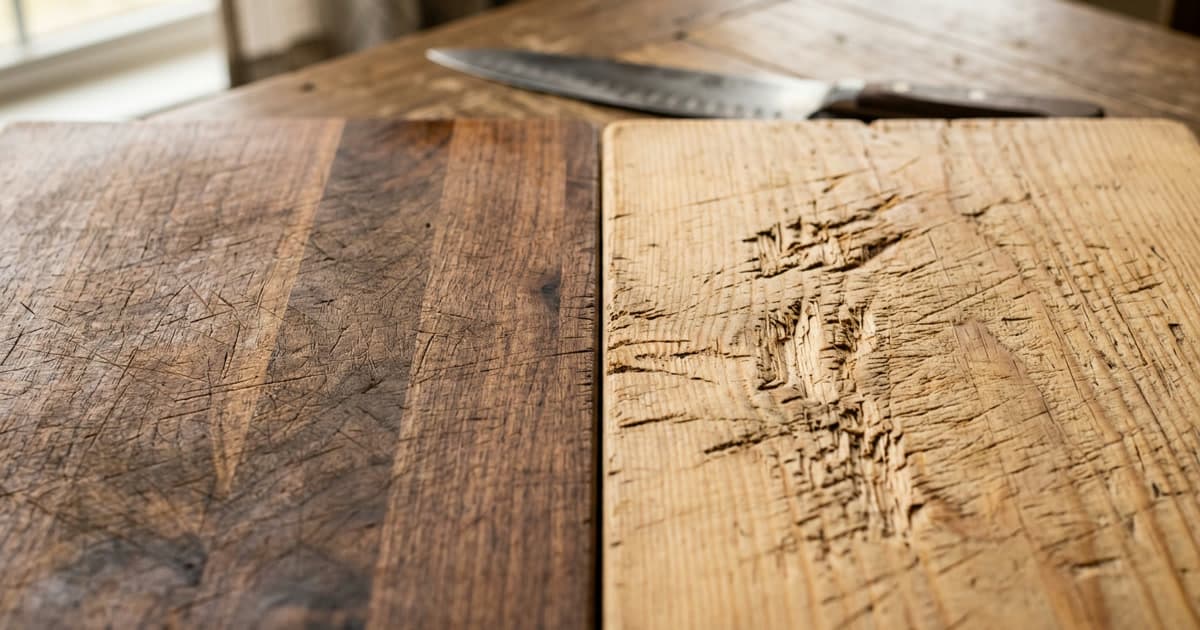
Not all wood belongs in the kitchen. If you have ever wondered why some wooden cutting boards last for decades while others fall apart in months, the answer almost always comes down to one fundamental distinction: hardwood versus softwood. Understanding this difference will save you money, protect your food, and help you choose kitchen items that are built to perform.
At Schmidt Woodcraft, every piece that leaves our Jacksonville, FL workshop is made from premium hardwood. That is not an arbitrary choice. It is a decision rooted in science, safety, and practical experience. Here is why hardwood is the right material for your kitchen and why softwood is not.
What Actually Makes a Wood "Hard" or "Soft"
The terms hardwood and softwood are not really about how hard the wood feels in your hand. They are botanical classifications based on how the tree reproduces. Hardwoods come from deciduous trees, the broad-leafed species that drop their leaves each fall. Think oak, maple, walnut, and cherry. Softwoods come from conifers, the needle-bearing evergreens like pine, spruce, cedar, and fir.
That said, the naming is not entirely misleading. Most hardwoods are in fact denser and harder than most softwoods. This is because hardwood trees generally grow more slowly, developing tighter, denser cell structures over their longer growing seasons. That density is exactly what makes them suitable for kitchen use.
There are exceptions in both directions. Balsa wood is technically a hardwood despite being extremely soft, while yew is a softwood that is reasonably hard. But for the species commonly used in kitchens, the rule holds: hardwoods are denser, tougher, and more resistant to the demands of food preparation.
Density and Durability in Daily Use
A cutting board takes more abuse than almost any other tool in your kitchen. Every time you chop, slice, or dice, your knife impacts the surface. Over years of daily use, those impacts add up. The wood needs to absorb that punishment without falling apart.
Hardwoods like hard maple (1,450 lbf on the Janka scale), walnut (1,010 lbf), and cherry (950 lbf) have the density to handle this. Their tight cell structure resists deep knife scars, maintains a smooth surface, and holds up to repeated washing without degrading. A well-made hardwood cutting board can easily last 20 years or more with basic care.
Softwoods tell a different story. Eastern white pine comes in at just 380 lbf on the Janka scale. Western red cedar sits at 350 lbf. These woods are so soft that a kitchen knife will gouge deep channels into the surface within weeks of regular use. Those channels trap food particles, harbor bacteria, and make the board nearly impossible to clean effectively. For a deeper look at how the top kitchen hardwoods compare to each other, see our cherry, maple, and walnut comparison guide.
Why Softwood Fails at Food Safety
The food safety problems with softwood in the kitchen go beyond simple durability. Softwoods have a more open, porous grain structure that creates several issues when the wood comes into contact with food.
First, the open pores absorb liquids readily and deeply. When raw meat juices, vegetable stains, or cooking oils soak into a softwood board, they penetrate far below the surface. Unlike hardwoods, where the tight grain traps bacteria in a dry environment where they die, softwood's loose structure allows moisture to linger. That persistent moisture creates conditions where bacteria can survive and even multiply.
Second, many softwoods contain resins and aromatic compounds that are not food-safe. Cedar, for example, contains natural oils called thujaplicins that give it its distinctive scent. While these compounds make cedar excellent for building decks, closets, and fence posts, they do not belong in contact with your food. The same is true for treated pine and most other conifer species.
Third, softwoods splinter more easily than hardwoods. As the board wears and knife scars accumulate, small wood fibers can break free from the surface. Nobody wants wood splinters in their meal preparation.
How Hardwood's Natural Properties Protect Your Food
Hardwoods do not just avoid the problems that softwoods create. They actively contribute to a safer food preparation environment. Research conducted at the University of California, Davis demonstrated that bacteria placed on hardwood cutting board surfaces were pulled below the surface by capillary action and subsequently died in the dry interior of the wood.
This happens because hardwood's dense cell structure creates narrow channels that pull moisture inward but do not allow it to pool. The bacteria travel with that moisture into an environment that cannot sustain them. On a plastic board, by contrast, bacteria remain on the surface in knife scars where they can thrive.
Certain hardwoods have additional antimicrobial properties. Walnut contains juglone, a compound that actively inhibits bacterial and fungal growth. All three of the primary kitchen hardwoods, maple, walnut, and cherry, contain tannins and other organic compounds that make the wood inhospitable to microorganisms.
Dimensional Stability Matters in the Kitchen
Kitchens are humid environments. Between steam from cooking, water from the sink, and the regular washing that cutting boards undergo, kitchen wood is constantly exposed to moisture fluctuations. How the wood responds to those changes determines whether your board stays flat and functional or warps into something unusable.
Hardwoods are significantly more dimensionally stable than softwoods. Their dense cell structure absorbs and releases moisture slowly and evenly, which means the wood expands and contracts in a controlled, predictable way. A properly dried and finished hardwood cutting board will stay flat on your counter for years.
Softwoods absorb moisture quickly and unevenly, which leads to warping, cupping, and twisting. A pine cutting board that sits next to a kitchen sink will start to deform within months. Once a board is warped, it rocks on the counter while you cut, which is both frustrating and dangerous.
Common Softwoods to Avoid in the Kitchen
If you are shopping for wooden kitchen items, here are the softwood species you should steer clear of:
- Pine. Cheap and widely available, but far too soft for cutting surfaces. It scars easily, absorbs stains deeply, and splinters with use. Pine is great for shelving and furniture, but it has no place as a food preparation surface.
- Cedar. The aromatic oils that make cedar pleasant in a closet are not food-safe. Cedar is also very soft and prone to splitting along its grain lines.
- Spruce and fir. Common construction lumber, but too soft and too resinous for kitchen use. These woods are designed to frame houses, not prepare food.
- Bamboo (a special case). Bamboo is technically a grass, not a wood, but it shows up in kitchen products frequently. While bamboo is reasonably hard, the boards are made from thin strips bonded with adhesives. Those glue joints can fail with moisture exposure, and the extremely hard surface is rough on knife edges.
The Best Hardwoods for Kitchen Use
Not every hardwood is ideal for the kitchen either. Open-pored species like red oak have grain that is too loose for food contact. The best kitchen hardwoods combine density, tight grain, food-safe properties, and visual appeal:
- Hard maple. The densest common kitchen wood. Tight grain, excellent durability, and a clean, light appearance. The traditional choice for professional butcher blocks.
- Walnut. A perfect balance of hardness, beauty, and antimicrobial properties. Walnut's rich color and flowing grain make it the most visually striking option.
- Cherry. A warm, medium-hardness wood that develops a gorgeous patina over time. Slightly softer than walnut but still very capable for daily kitchen use.
We use all three of these species in our workshop, and each one has earned its place through performance, safety, and lasting beauty. You can see all of them in our current product collection.
Why Price Alone Is Misleading
One reason softwood kitchen products exist on the market is price. A pine cutting board is significantly cheaper to produce than a walnut one, and the price tag reflects that. But the true cost of a kitchen item is not what you pay at checkout. It is the total cost over the life of the product.
A softwood cutting board that costs fifteen dollars and needs to be replaced every year is more expensive over a decade than a hardwood board that costs eighty dollars and lasts twenty years. The hardwood board also provides a safer, more hygienic cutting surface every single day you use it. And it looks better on your counter.
When we build a cutting board from walnut, maple, or cherry, we are building something that will be in your kitchen long after you have forgotten what you paid for it. That is the value proposition of hardwood: it costs more up front and saves you money, frustration, and compromise for years to come.
Choose Wood That Works as Hard as You Do
Your kitchen deserves materials that can keep up with the way you cook. Hardwood delivers on that promise in a way that softwood simply cannot. The density protects against wear. The tight grain keeps your food safe. The dimensional stability keeps the board flat and reliable. And the natural beauty turns a kitchen tool into something you are proud to have on display.
Every piece we build at Schmidt Woodcraft uses only premium hardwoods that have been selected, dried, and finished specifically for kitchen use. Browse our collection to find the right piece for your kitchen, or reach out about a custom order if you have something specific in mind.
Looking for the perfect cutting board?
Every board we make is built by hand in our Jacksonville, FL workshop using premium hardwoods. Browse our collection or request a custom piece.