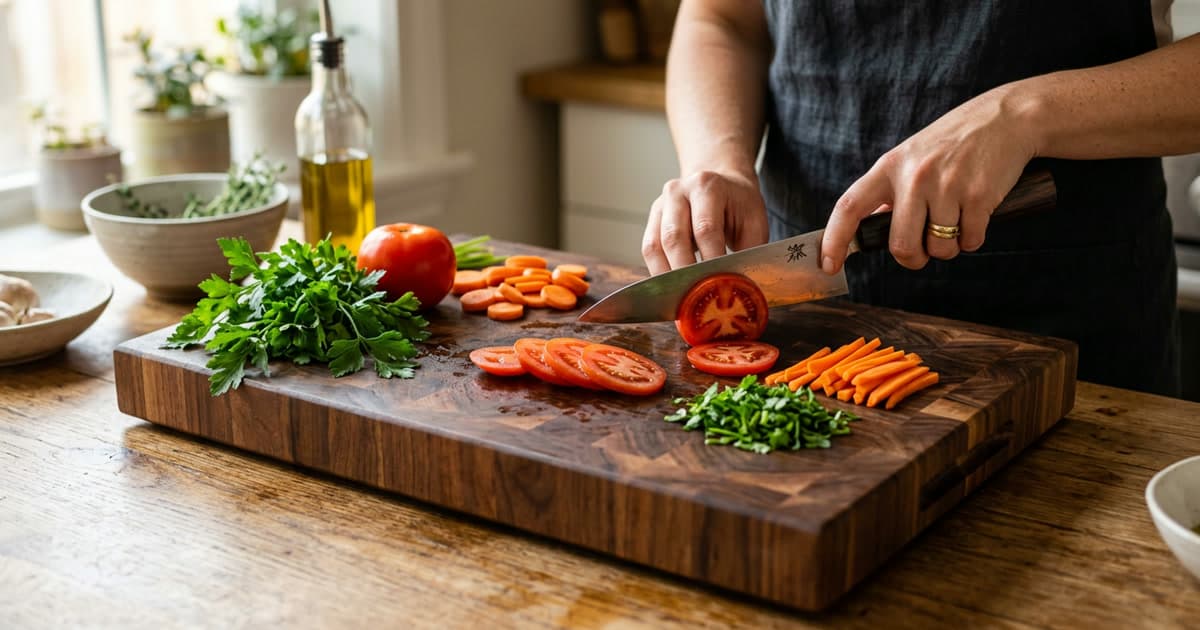
You are standing in the kitchen aisle, looking at a wall of cutting boards priced between eight and twenty dollars. Then you come across a handmade hardwood board priced at ten times that. Your first thought is reasonable: why would anyone spend that much on a cutting board?
We hear this question often at Schmidt Woodcraft, and we think it deserves a real answer. Not a sales pitch, but an honest look at what you get when you invest in a handmade cutting board versus grabbing whatever is on the shelf. The short version is that you end up spending less over time, cooking on a better surface, and owning something that actually lasts. Here is the longer version.
What You Are Really Buying at the Big Box Store
Mass-produced cutting boards are designed to hit a price point. That is the primary engineering goal. Every decision about materials, thickness, finish, and construction method is made to keep costs as low as possible while still putting a functional product on the shelf.
That means thin boards made from lower-grade wood, bamboo that splinters after a few months, or plastic that scores deeply the first time you use a sharp knife. The glue joints are done quickly. The wood is not always properly dried. The finish is sprayed on in seconds rather than hand-applied and cured.
None of this makes them terrible products. They work. But they work the way a disposable razor works. You use it for a while, it degrades, and you replace it. Most mass-produced cutting boards last one to three years before they warp, crack, develop deep knife scars, or simply start to look and feel worn out.
What Goes into a Handmade Board
When we build a cutting board in our Jacksonville, FL workshop, the process starts with selecting the wood. We use hard maple, walnut, and cherry, all premium hardwoods chosen for density, grain pattern, and durability. Every board is milled from lumber we have inspected by hand.
The wood needs to be properly dried and acclimated before we can work with it. Rush this step and the board will warp or crack within a year. We do not rush it. Once the wood is ready, each piece is precisely milled, glued with FDA-approved, waterproof adhesive, clamped under pressure, and left to cure fully before we move on.
After the glue-up, every board is sanded through multiple grits until the surface is glass-smooth. We round the edges and corners so they feel comfortable in your hands. Then we apply multiple coats of food-safe mineral oil and beeswax finish, letting each coat absorb before adding the next. The entire process takes days, not minutes.
Durability That Actually Matters
A well-made hardwood cutting board will last 15 to 25 years with basic care. Some last even longer. We have customers using boards they bought from us years ago that still look and perform beautifully. The wood develops a patina over time that actually makes it more attractive.
Compare that to replacing a cheap board every year or two. Over a decade, you might go through five or six mass-produced boards. Add up those costs and the "expensive" handmade board starts looking like the budget option.
But longevity is about more than just cost savings. There is something to be said for owning a kitchen tool that you know and trust. You learn where to position it on the counter. You get used to the weight. It becomes part of how you cook, not just something you cook on.
Better for Your Knives
This is a detail that most people overlook, but it matters a lot if you own decent knives. The surface you cut on affects how long your edge lasts between sharpenings.
Hardwoods like maple and walnut have a grain structure that gives slightly under the knife edge. Your blade presses into the wood fibers rather than slamming against a hard, unyielding surface. This means your knives stay sharper longer, which means less time sharpening and less steel removed from your blades over the years.
Glass and ceramic cutting boards are the worst offenders. They will dull a sharp knife in a single use. Plastic is better but still harder on edges than wood. And thin, low-quality wood boards often use species that are too soft, which creates deep grooves, or too hard, which beats up your knives. A well-chosen hardwood strikes the right balance.
Food Safety You Can Trust
One of the most common arguments against wooden cutting boards is that they are unsanitary. Research from UC Davis proved the opposite. Hardwood cutting boards are naturally antibacterial. Bacteria are pulled below the surface by the wood grain, where they cannot survive in the dry interior. Plastic boards, by contrast, develop permanent knife scars that harbor bacteria even after washing.
We wrote a detailed breakdown of this research in our post on wood vs plastic cutting boards if you want to dig into the science. The takeaway is that a quality hardwood board is not just as hygienic as plastic. It is more hygienic, especially as both materials age.
The Look and Feel of Real Craftsmanship
We would be leaving something out if we only talked about function. A handmade cutting board is genuinely beautiful. The grain patterns in a piece of walnut or the warm glow of oiled cherry are things that no factory process can replicate because they come from the natural character of the wood itself.
A quality cutting board does not hide in a drawer. It sits on your counter, and it makes your kitchen look better. When guests come over, it doubles as a serving surface. When you are cooking dinner on a Tuesday night, it makes the routine feel a little more intentional. These are small things, but they add up to a kitchen that feels like yours.
What to Look for When Buying
If you are considering investing in a handmade cutting board, here are the details worth paying attention to:
- Wood species. Hard maple, walnut, and cherry are the gold standard. Avoid boards made from soft woods like pine or from bamboo, which can splinter and is harder on knives than it appears.
- Thickness. A good cutting board should be at least one inch thick for edge grain and one and a half inches for end grain. Thinner boards warp more easily and feel less stable on the counter.
- Finish. Look for food-safe mineral oil and beeswax. Avoid boards finished with varnish or polyurethane, which can chip into food.
- Construction. Check that the glue joints are tight and even. In an end grain board, the checkerboard pattern should be consistent, with no gaps or misaligned pieces.
- Weight. A quality board has heft. It should feel solid and stay put on your counter without sliding around.
The Real Cost Comparison
Let us put real numbers to this. A typical mass-produced plastic or bamboo cutting board costs around 15 to 25 dollars and lasts about two years. Over 20 years, that is roughly 150 to 250 dollars in replacement boards, not counting the frustration of warped surfaces and dulled knives.
A handmade hardwood cutting board typically costs between 80 and 200 dollars depending on size, wood species, and construction style. With basic care, that one board lasts the full 20 years. When you factor in reduced knife sharpening costs and the simple pleasure of using a tool you love, the value is not even close.
We are not saying cheap boards do not have their place. If you need a beater board for breaking down raw chicken and you do not want to think about it, a basic plastic board is fine for that. But your primary cutting board, the one you reach for every single day, deserves to be something better.
An Investment in How You Cook
Cooking is one of those daily activities that can feel like a chore or a craft, and the tools you use play a bigger role in that than most people realize. A cutting board that feels good in your hands, stays stable on the counter, treats your knives well, and looks beautiful on the countertop changes the experience of cooking. Not dramatically. Subtly. In the way that a well-made tool always does.
Every board we build at Schmidt Woodcraft is made to be that kind of tool. Something you buy once, use daily, and never think about replacing. If you are ready to upgrade your kitchen with a board that will last, browse our collection or reach out about a custom board built to your exact specifications.
Looking for the perfect cutting board?
Every board we make is built by hand in our Jacksonville, FL workshop using premium hardwoods. Browse our collection or request a custom piece.