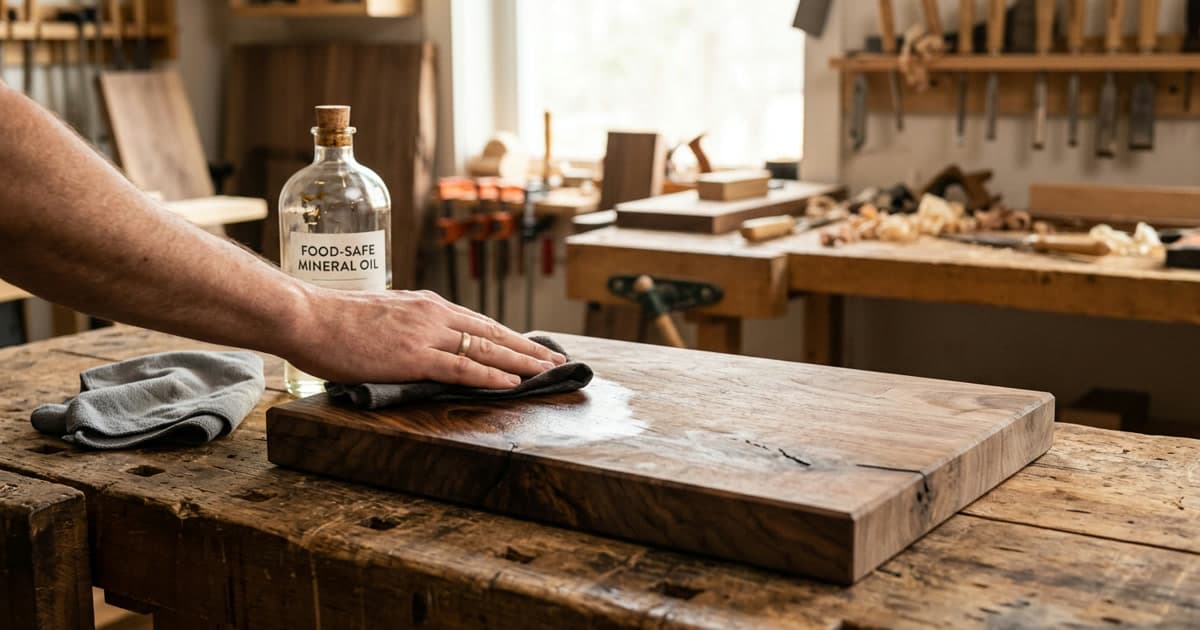
If you own a wooden cutting board, serving tray, or any kitchen item that touches food, the finish on that wood matters. It is what stands between the raw wood and the foods your family eats. The right finish protects the wood, keeps it looking beautiful, and is completely safe for food contact. The wrong finish can introduce chemicals you do not want anywhere near your kitchen.
At Schmidt Woodcraft, every product that leaves our Jacksonville workshop is finished with food-safe materials. We are particular about this because we believe you should never have to wonder whether your cutting board is safe to use. Here is a clear guide to food-safe finishes, what works, what to avoid, and how we approach finishing in our shop.
What Makes a Finish Food-Safe
A food-safe finish is any coating or treatment that is non-toxic after it has fully cured or that is inherently non-toxic in its liquid state. The distinction matters because some finishes that are perfectly safe once dry are not safe while still wet or uncured. Others are safe at every stage.
For kitchen woodwork, we prefer finishes that are safe from start to finish, meaning they are non-toxic in their raw form, during application, and throughout the life of the product. This eliminates any guesswork about whether a finish has fully cured or whether a re-application might introduce something harmful.
The three most common food-safe finishes for kitchen wood products are mineral oil, beeswax, and certain plant-based oils. Each one has different properties, and most quality finishing regimens use a combination rather than a single product.
Mineral Oil: The Foundation
Food-grade mineral oil is the most widely recommended finish for wooden cutting boards and kitchen items, and for good reason. It is odorless, tasteless, colorless, and completely inert. It does not go rancid. It does not react with food. It does not change the flavor of anything that touches the surface. It is the same material sold in pharmacies as a digestive aid, so its safety for food contact is well established.
Mineral oil works by penetrating the wood fibers and filling the tiny spaces between them. This creates a moisture barrier that prevents water from soaking into the wood, which in turn prevents warping, cracking, and bacterial growth. The oil does not form a hard film on the surface the way a varnish or lacquer does. Instead, it saturates the wood from within, keeping it hydrated and resilient.
The one limitation of mineral oil is that it does not stay put forever. With regular washing, the oil gradually washes out of the wood, which is why cutting boards need periodic re-oiling. This is normal maintenance, not a flaw in the finish. A freshly oiled board has a rich, warm appearance and a smooth feel that tells you the wood is well protected. For a step-by-step guide on oiling and maintaining your boards, visit our wood care guide.
Beeswax: The Protective Layer
Beeswax is a natural product that has been used as a wood finish for centuries. On its own, it provides a soft, protective coating that adds a subtle sheen and helps repel moisture. But beeswax really shines when combined with mineral oil in what is commonly called board cream or board butter.
A mineral oil and beeswax blend gives you the best of both worlds. The mineral oil penetrates the wood and conditions it from within, while the beeswax sits on the surface and creates a more durable barrier against water and stains. The result is a finish that lasts longer between applications, resists moisture more effectively, and gives the wood a beautiful, hand-rubbed look.
We use a mineral oil and beeswax blend as the final step in finishing our cutting boards and serving pieces. The wax fills the surface pores and creates a smooth, slightly waxy feel that is pleasant to the touch. It is completely food-safe, easy to reapply at home, and it smells faintly of honey, which is a nice bonus.
Plant-Based Oils: Know the Difference
This is where things get tricky, because not all plant-based oils are appropriate for kitchen woodwork. Some are excellent. Some are actively harmful. The difference comes down to one critical property: whether the oil goes rancid.
Walnut oil is a popular food-safe option. It dries and hardens over time, creating a durable finish that enhances the natural grain of the wood. It is safe for food contact and gives the wood a warm, slightly amber tone. The main drawback is that walnut oil is a tree nut product, and people with severe nut allergies should avoid cutting boards finished with it. We always note when a product uses walnut oil for this reason.
Raw linseed oil (also called flaxseed oil) is another traditional wood finish that is food-safe. It takes a long time to cure fully, sometimes weeks, but once cured it creates a hard, protective surface. Do not confuse raw linseed oil with boiled linseed oil, which contains metallic drying agents and is not food-safe.
Tung oil in its pure, unprocessed form is food-safe once fully cured. It creates a hard, water-resistant finish. However, many products sold as "tung oil" are actually tung oil blends that contain petroleum solvents and other additives that are not safe for food contact. If you use tung oil, make sure it is 100% pure tung oil with no additives.
Finishes to Avoid on Kitchen Wood
Several common wood finishes have no place on products that will touch food. If you are buying a cutting board or kitchen item and the seller cannot tell you exactly what finish was used, that is a concern.
Cooking oils like olive oil, canola oil, and vegetable oil should never be used on cutting boards. They will go rancid inside the wood, creating an unpleasant smell and taste that is nearly impossible to remove. We see this mistake often with well-intentioned home maintenance. Someone finishes their board with olive oil because it seems natural and food-safe. Weeks later, the board smells off and the surface has turned sticky. Always use food-grade mineral oil instead.
Polyurethane, lacquer, and varnish are film-forming finishes designed for furniture and flooring. They create a hard, plastic-like shell on the surface that cracks and peels under the stress of knife cuts. Once cracked, moisture gets underneath and the finish fails. These coatings are also not rated for direct food contact in most formulations. They have no place on a cutting board.
Boiled linseed oil contains metallic driers, typically cobalt or manganese compounds, that speed up the curing process. These additives make the finish unsuitable for food contact. Boiled linseed oil is fine for furniture, tool handles, and outdoor woodwork, but it should never be used on anything that touches food.
Stains and dyes are designed to change the color of wood. Most are not food-safe, and even those marketed as non-toxic are not intended for surfaces that will be cut on, washed repeatedly, and used to prepare food. A quality cutting board does not need staining. The natural color of the wood is beautiful on its own.
How We Finish Our Products
Our finishing process is straightforward and we are completely transparent about it. Every cutting board and kitchen piece goes through the same steps.
After final sanding, we apply multiple coats of food-grade mineral oil, allowing each coat to soak in fully before applying the next. This initial saturation fills the wood fibers and establishes a solid moisture barrier throughout the piece. We typically apply three to four coats over the course of a couple of days.
Once the mineral oil has been fully absorbed, we apply our beeswax and mineral oil blend as a topcoat. This is rubbed into the surface by hand, allowed to sit, and then buffed to a soft sheen. The result is a finish that is completely food-safe, beautiful to look at, and pleasant to use.
This finishing process takes time, and we do not rush it. Each coat needs to absorb fully before the next one goes on. Rushing creates a surface that feels oily or greasy because the excess has not had time to penetrate. We would rather take an extra day than send out a product that does not feel right.
Maintaining the Finish at Home
No matter how well a cutting board is finished initially, the finish will need maintenance over time. Regular washing gradually removes oil from the surface, and the board will eventually look and feel dry. This is completely normal.
Re-oiling is simple. Apply a generous coat of food-grade mineral oil, let it soak in for a few hours or overnight, and wipe off the excess. How often you need to do this depends on how frequently you use and wash the board. Heavy daily use might call for oiling every two to three weeks. Occasional use might only need oiling once every couple of months. For more detailed guidance on oiling schedules and techniques, check out our post on the best oils for wooden kitchen items.
The water test is the easiest way to know when your board needs oil. Sprinkle a few drops of water on the surface. If the water beads up, the finish is in good shape. If the water absorbs quickly into the wood, it is time for a fresh coat.
A Finish You Can Trust
The finish on your kitchen woodwork should never be something you have to worry about. When you buy from a maker who uses proper food-safe finishes and is willing to tell you exactly what those finishes are, you can use your cutting board, serve food on your charcuterie board, and hand your child a wooden spoon without a second thought.
Every piece in our product collection is finished exclusively with food-safe materials. If you have questions about finishes, wood species, or anything else about our products, we are always happy to talk. And if you are looking for a custom piece with specific finishing requirements, send us a custom order request and we will build it to your exact needs.
Looking for the perfect cutting board?
Every board we make is built by hand in our Jacksonville, FL workshop using premium hardwoods. Browse our collection or request a custom piece.