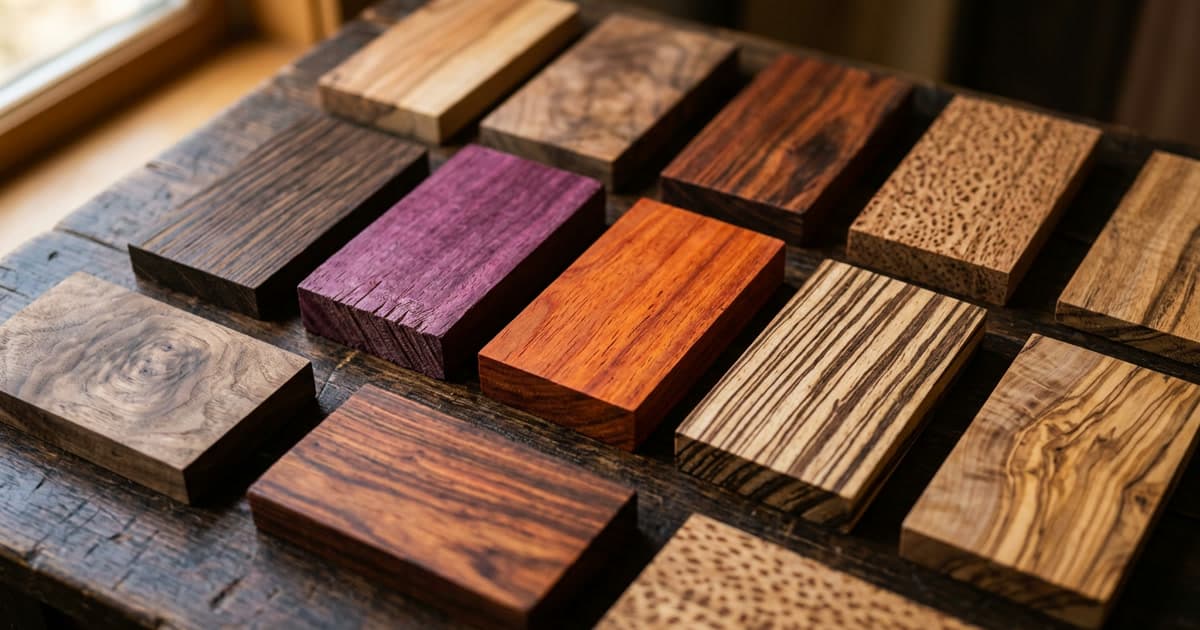
Walk into a kitchen with a cutting board that features a stripe of vivid orange-red padauk or a ribbon of deep purple purpleheart, and it stops you in your tracks. Exotic woods bring a kind of visual impact that domestic species simply cannot replicate. Their colors are bolder, their grain patterns more unusual, and their presence in a piece of woodwork signals something beyond the ordinary.
At Schmidt Woodcraft, we use exotic hardwoods selectively in our work. They are not the foundation of our pieces. Domestic hardwoods like walnut, maple, and cherry handle the heavy lifting. But exotic species serve as accents, adding color and contrast that transform a well-made board into something truly striking. Here is what you should know about these remarkable woods.
What Makes a Wood "Exotic"
In American woodworking, the term exotic generally refers to wood species that are not native to North America. Most come from tropical regions of Central and South America, Africa, and Southeast Asia. What sets them apart is not just their origin but their properties: colors that range from vivid oranges and purples to deep reds and jet blacks, grain patterns that can be striped, interlocked, or wildly figured, and densities that are often significantly higher than domestic hardwoods.
These properties are the result of growing conditions. Tropical trees face intense competition for sunlight, develop complex chemical compounds to resist insects and rot, and grow in conditions that produce dense, hard timber. The same chemistry that protects the tree in a rainforest produces the vivid colors and exceptional durability that make exotic woods so desirable in woodworking.
Padauk: Bold and Warm
African padauk is one of the most visually striking woods in the world. When freshly cut, the heartwood is a vivid orange-red that practically glows. Over time, padauk mellows to a warm, deep reddish-brown, though it retains a warmth that sets it apart from domestic species.
Padauk is very hard, rating around 1,970 lbf on the Janka scale, which makes it exceptionally durable. It has an interlocked grain that resists splitting, and it finishes to a smooth, almost glassy surface. We use padauk as an accent stripe in cutting boards and serving pieces, where its color creates a bold contrast against walnut's deep brown or maple's creamy white.
From a food safety standpoint, padauk is a closed-grain hardwood that performs well in kitchen applications. Its density prevents bacterial penetration, and it responds well to food-safe mineral oil finishes. The color is natural to the wood and does not leach into food during normal use.
Purpleheart: Dramatic and Dense
Purpleheart lives up to its name. When freshly machined, the wood oxidizes from a dull brown to a vibrant, saturated purple within hours of exposure to light. It is one of the few truly purple materials found in nature, and the effect in a finished piece is remarkable.
Native to Central and South America, purpleheart is extremely hard at around 1,860 lbf on the Janka scale. This makes it highly resistant to wear and denting, and it holds up exceptionally well as an accent element in pieces that see daily use. The grain is typically straight, which gives it a clean, uniform appearance that contrasts nicely with the more figured patterns of walnut or cherry.
Over time, purpleheart will shift from bright violet toward a deeper, more muted eggplant tone. Regular oiling can slow this process and keep the color more vivid. Many of our customers appreciate the way purpleheart changes, seeing it as part of the piece's living character. A cutting board that features purpleheart accents at five years old has a richness that a new board simply does not have.
Zebrawood: Striped and Striking
Zebrawood earns its name from the bold, dark streaks that run through its light golden-tan heartwood. The contrast between the dark stripes and light background creates one of the most instantly recognizable grain patterns in woodworking. Even people who know nothing about wood species will notice zebrawood in a piece.
Native to West Africa, zebrawood has a Janka hardness of about 1,575 lbf, placing it firmly in the hard category. The grain can be interlocked, which makes it challenging to work but also contributes to its structural strength. We use zebrawood sparingly because its bold pattern works best as an accent rather than a primary surface. A single strip of zebrawood in an otherwise understated walnut board adds exactly the right amount of visual interest without overwhelming the piece.
Other Notable Exotic Species
Beyond padauk, purpleheart, and zebrawood, several other exotic hardwoods make occasional appearances in our work:
- Wenge. A dark, nearly black wood from Africa with a coarse, dramatic grain. Wenge adds depth and contrast when paired with lighter woods like maple. It is extremely hard at 1,630 lbf and very durable.
- Bloodwood. A deep, saturated red that is even more vivid than padauk. Bloodwood is extraordinarily dense and finishes beautifully, though it can be challenging to work due to its hardness.
- Yellowheart. A bright, sunny yellow that provides a lighter accent option. Yellowheart is hard and dense, and it adds warmth and energy to multi-wood compositions.
- Jatoba. Also known as Brazilian cherry, jatoba has a warm reddish-brown tone and is one of the hardest commercially available woods at 2,350 lbf. It is often used when extreme durability is needed.
Food Safety Considerations
Whenever we incorporate exotic woods into kitchen pieces, food safety is the primary concern. Not every exotic species is appropriate for food contact, and we are careful about which ones we use.
The exotic woods in our kitchen pieces, padauk, purpleheart, zebrawood, and the others listed above, are all closed-grain hardwoods that do not leach harmful compounds during normal kitchen use. They are finished with the same food-safe mineral oil and beeswax blend that we use on all our kitchen products.
Some exotic species are known to cause skin irritation or respiratory issues during the woodworking process, which is a concern for the craftsperson but not for the end user. Once the wood is cut, sanded, and sealed with a food-safe finish, the dust that causes those reactions is no longer present. The finished surface is inert and safe for food contact.
We do avoid certain exotic species in kitchen products. Woods with high natural oil content that could interfere with food-safe finishes, or species with documented toxicity concerns, never make it into our kitchen line. Every wood we use has been researched and vetted for food-contact suitability.
Sustainability and Responsible Sourcing
Using exotic woods comes with a responsibility to source them ethically. Tropical deforestation is a serious global concern, and the woodworking community has a role to play in ensuring that demand for exotic species does not contribute to habitat destruction.
We source our exotic lumber from suppliers who can verify legal and sustainable harvesting practices. Many of the species we use are not endangered and are harvested from managed forests or plantations. We also minimize waste by using exotic woods as accents rather than primary materials, which means a small amount of exotic lumber goes a long way in our workshop.
The fact that we use domestic hardwoods as the foundation of our pieces is partly a sustainability decision. Walnut, maple, and cherry are abundant, domestically harvested species with well-established forestry management practices. By using exotics sparingly, as contrast stripes, inlays, and decorative elements, we get the visual impact without the heavy environmental footprint. For more on how we choose and use our primary domestic woods, read our comparison of cherry, maple, and walnut.
How Exotic Accents Transform a Piece
The power of exotic wood is in how it interacts with the domestic species around it. A walnut cutting board is beautiful on its own. Add a thin stripe of padauk running through the center, and it becomes a conversation piece. The contrast between walnut's deep chocolate tones and padauk's warm orange-red creates a visual tension that draws the eye and holds attention.
We think of exotic accents the way a painter thinks about color. The domestic hardwood provides the canvas, the foundation of tone and texture. The exotic accent provides the highlight, the element that makes the piece memorable. Too much exotic wood can overwhelm. Used with restraint, it elevates.
Some of our favorite combinations include walnut with purpleheart, maple with padauk, and multi-species boards that incorporate three or four woods in a carefully balanced composition. Each combination creates a different mood and works in different kitchen environments.
Finding the Right Piece
If the idea of exotic wood accents appeals to you, the best way to see how they work in practice is to look at actual pieces. Browse our current collection to see which boards feature exotic accents, and pay attention to how the colors interact with the domestic hardwood backgrounds.
We are also happy to build custom pieces that incorporate specific exotic species. If you have a color combination in mind, or if you want to match a piece to your kitchen's color palette, submit a custom order request and tell us what you are envisioning. We will work with you on species selection, layout, and sizing to create something that is uniquely yours.
Looking for the perfect cutting board?
Every board we make is built by hand in our Jacksonville, FL workshop using premium hardwoods. Browse our collection or request a custom piece.