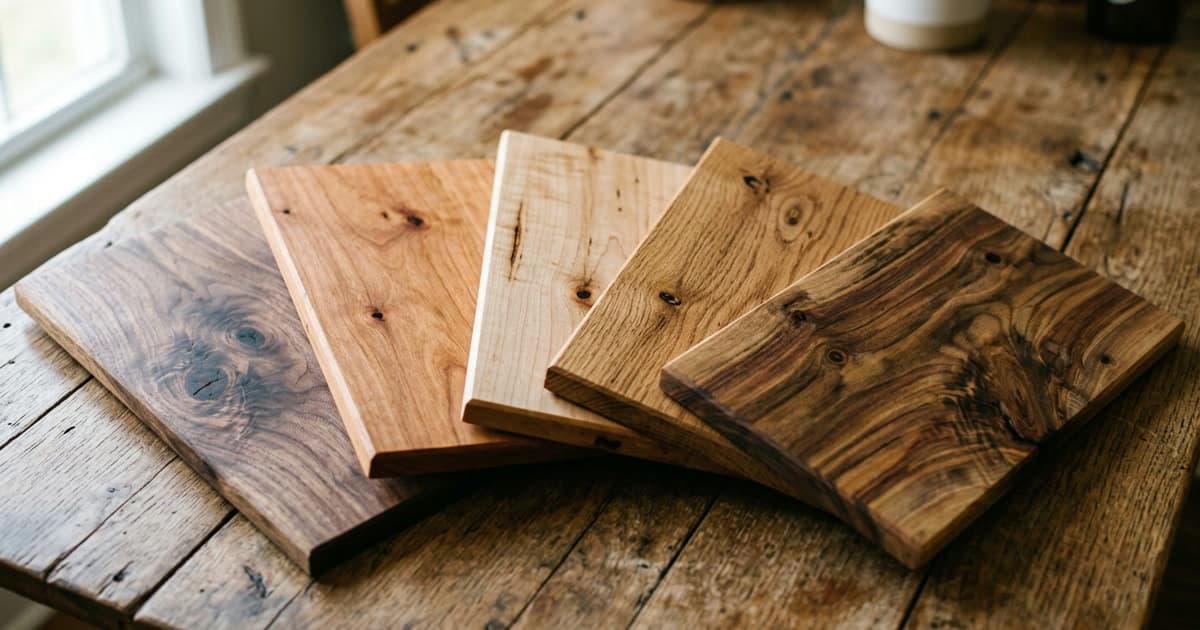
When you order a handmade wooden cutting board or kitchen piece, the product you receive will not look exactly like the photo. It cannot. The wood itself guarantees that. Every board, every plank, every strip of lumber carries its own grain pattern, color variations, and natural character marks that are unlike any other piece of wood on earth.
For some buyers, that takes a moment to get used to. We understand. If you are accustomed to manufactured products where every unit is identical, natural variation can feel unexpected. But once you understand why wood varies and what those differences mean, you will start to see them for what they truly are: the defining feature that makes your piece yours and nobody else's.
How a Tree Creates Its Own Fingerprint
Wood grain is the visible record of a tree's life. Every ring represents a year of growth, and the conditions of that year are written into the wood. A wet spring produces wider, lighter growth. A dry summer produces tighter, denser fibers. A season of strong wind causes the tree to grow thicker on one side to brace itself. Disease, insect activity, mineral deposits in the soil, nearby root systems, even the angle of sunlight through the canopy all leave their mark.
These factors combine in infinitely variable ways. Two walnut trees growing ten feet apart in the same forest will produce lumber with noticeably different grain patterns. Even boards cut from the same tree look different depending on where in the trunk they came from. The wood near the center, called heartwood, is darker and denser. The outer wood, called sapwood, is lighter and more porous. The angle of the saw through the log determines whether the grain appears straight, arched, or swirling.
This is why no two pieces of wood are alike. It is not a limitation of the material. It is a fundamental property of how trees grow.
Grain Patterns and What They Tell You
The most visible form of variation is grain pattern. Straight grain, where the lines run parallel down the length of the board, comes from trees that grew tall and upright in dense forest conditions. It is clean, orderly, and consistent. Many people find it calming and elegant.
Cathedral grain, sometimes called flame grain, features sweeping arches that look like pointed windows. This pattern appears when the saw cuts through the growth rings at an angle, revealing their curved shape. It is dramatic and eye-catching, and it gives a piece of woodwork an energy that straight grain does not.
Curly or figured grain is caused by a genetic variation in the tree that makes the wood fibers grow in a wavy pattern. When light hits curly grain at different angles, it shimmers and shifts in a way that is almost three-dimensional. Curly maple is one of the most prized figured woods, and pieces with strong curl are genuinely rare.
Each of these patterns emerges naturally. A woodworker can select boards with a particular type of grain, but no one can dictate the exact pattern the tree produced. What you see in a finished piece is the result of biology, climate, time, and a bit of luck.
Color Variation Is Natural and Expected
Wood color varies not just between species but within a single board. Walnut heartwood ranges from chocolate brown to purplish black, sometimes with streaks of lighter sapwood at the edges. Cherry starts as a pale pinkish color and deepens to a rich, warm reddish-brown over months and years of exposure to light. Hard maple is generally creamy white, but it can carry mineral streaks of gray, green, or brown where the tree absorbed different compounds from the soil.
These color variations are completely natural and have no effect on the structural integrity or performance of the wood. A walnut cutting board with a lighter streak is exactly as strong, durable, and food-safe as one with perfectly uniform color. The light streak is simply a section of sapwood that grew on the outer edge of the tree.
In our workshop, we select wood thoughtfully and arrange each piece to make the most of its natural coloring. Sometimes that means pairing contrasting tones for visual interest. Other times it means grouping boards with similar coloring for a more uniform look. But we never reject good wood simply because its color is not perfectly even, and neither should you.
Character Marks: Knots, Mineral Streaks, and More
Beyond grain and color, wood carries character marks that add personality to a finished piece. Small knots are remnants of branches that once grew from the tree. Mineral streaks are deposits left behind as groundwater moved through the living wood. Pin knots, tiny dark spots no larger than a pinhead, mark places where small twigs began to grow and then stopped.
In factory production, these features are often treated as defects. Boards with visible character marks are downgraded, discarded, or hidden. A craftsperson takes a different view. Small, tight knots that are structurally sound add visual interest without compromising the piece. Mineral streaks tell the geological story of where the tree grew. These marks make wood look like wood rather than like a synthetic imitation.
There is an important distinction here between character and defect. A small, stable knot in a serving tray is character. A loose knot in a cutting board that could harbor bacteria or trap food particles is a defect. We know the difference, and we select accordingly. Every character mark in a Schmidt Woodcraft piece is there because it adds to the beauty of the product without compromising its function. For more on how we think about wood selection, see our comparison of cherry, maple, and walnut.
Why Uniformity Is Actually a Warning Sign
Here is something worth thinking about when you shop for wooden products. If every board in a product listing looks absolutely identical, something is off. Either the photos are heavily edited, the product is made from laminated or engineered material rather than solid wood, or the surface has been stained to hide the natural variation underneath.
Real solid wood does not look uniform. It cannot. And products marketed with promises of "consistent appearance" or "uniform grain" are often using those phrases to describe processed materials that lack the depth and character of genuine hardwood.
The most honest and transparent woodworkers show their products as they actually are, with natural variation included. They might note that grain patterns will differ from piece to piece, because that is the truth of working with a natural material. When you see that kind of honesty in a product listing, it is actually a mark of quality and confidence in the material being used.
How We Handle Variation in Our Workshop
We embrace natural variation, but that does not mean we take a careless approach to material selection. Every board that comes into our shop is inspected, sorted, and stored under controlled conditions. When we start building a piece, we lay out the lumber and arrange it for the best visual result before any cutting begins.
For cutting boards with multiple wood strips, we pay attention to how grain patterns flow from one strip to the next. We match boards for complementary color tones. We orient the grain for structural stability so the board will stay flat through years of use and humidity changes. This process takes time, but it is the difference between a piece that looks assembled and a piece that looks composed.
When you order a custom piece, we are happy to discuss wood selection in detail. If you prefer a more uniform appearance, we can select boards with tighter, more consistent grain. If you love dramatic figure and bold contrast, we can build your piece to showcase those features. The beauty of handmade work is that these decisions are made by a person, not a production line.
Embracing What Makes Your Piece Yours
The cutting board on your counter is not just a kitchen tool. It is a piece of a tree that grew for decades, shaped by rain and drought, sunlight and shade, soil and season. The grain pattern you see is a record of that life, compressed into the wood fibers and revealed by the saw. No factory can replicate it because no factory planted the tree, waited fifty years for it to grow, and then selected that exact board for your kitchen.
That is what makes handmade woodwork different from everything else. Every piece carries the story of its material, and no two stories are the same. When you understand that, variation stops being something to tolerate and becomes something to appreciate.
Ready to find a one-of-a-kind piece for your kitchen? Browse our collection of handcrafted cutting boards, serving pieces, and kitchen items. Each one is genuinely unique, built from wood that will never be duplicated.
Looking for the perfect cutting board?
Every board we make is built by hand in our Jacksonville, FL workshop using premium hardwoods. Browse our collection or request a custom piece.