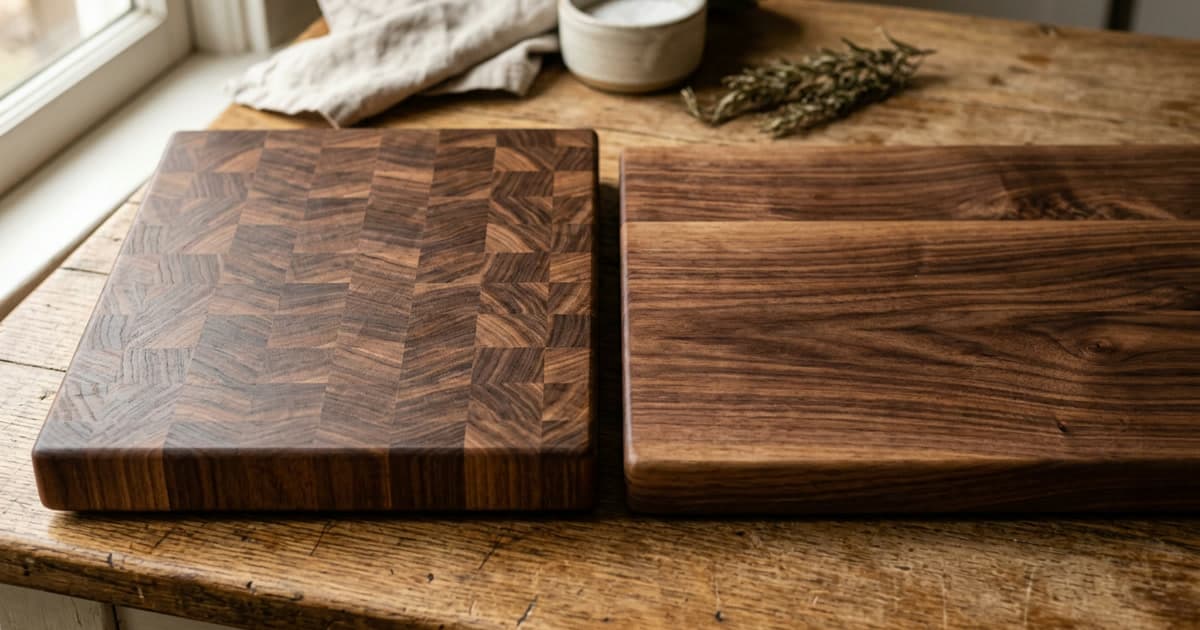
When you start shopping for a quality wooden cutting board, you will quickly run into two terms: end grain and edge grain. These describe how the wood is oriented in the board, and the difference is more than cosmetic. Each construction style has distinct advantages that affect how the board performs, how long it lasts, how it treats your knives, and how it looks on your counter.
We build both styles in our Jacksonville, FL workshop, and customers often ask which one is better. The honest answer is that neither is universally better. Each one is better suited for different uses and preferences. Here is everything you need to know to make the right choice for your kitchen.
How They Are Made
Understanding the difference starts with understanding how wood works. A tree grows in long fibers that run vertically from roots to branches. When you cut a board from a tree, the direction you orient those fibers determines whether you end up with end grain or edge grain.
Edge grain boards are made by gluing strips of wood together with the long grain facing upward. Picture a series of planks standing on their edges, glued side by side. The cutting surface shows the long, straight grain lines that run the length of the board. This is the more traditional construction method and the one most people picture when they think of a wooden cutting board.
End grain boards are made by cutting those strips into shorter blocks and then arranging them so the ends of the wood fibers face upward. The cutting surface shows a checkerboard-like pattern of exposed fiber ends. This is the same surface you see when you look at the end of a log or a butcher block. It is a more labor-intensive construction method, which is part of why end grain boards typically cost more.
How They Perform Under the Knife
This is where the most significant practical difference shows up. When you cut on an edge grain board, your knife slices across the wood fibers. The blade severs them cleanly, which creates thin knife marks over time. These marks are cosmetic at first, but deep cuts can eventually become grooves that are harder to clean.
When you cut on an end grain board, your knife slides between the upright wood fibers rather than cutting across them. Think of it like pushing a blade into the bristles of a brush. The fibers separate to let the knife through, then close back up when the blade is removed. This self-healing quality means end grain boards show fewer visible knife marks over time and maintain a smoother cutting surface.
This fiber behavior also means that end grain boards are significantly easier on your knife edges. Your blade is not slamming into resistant long-grain fibers with every cut. Instead, it is slipping between fibers that give way gently. If you have invested in quality knives, an end grain board will help them stay sharper longer between sharpenings.
Durability and Longevity
Both edge grain and end grain boards are built to last for decades with proper care. However, they age differently.
Edge grain boards are strong and resistant to warping because the long grain provides structural stability across the width of the board. They are less likely to develop issues from uneven drying or moisture changes. For this reason, edge grain boards are often recommended for heavy-duty prep tasks and for environments where humidity levels fluctuate, something we think about often here in Jacksonville with our Florida humidity.
End grain boards are exceptionally hard on the cutting surface because you are working against the hardest part of the wood fiber. But the construction involves more glue joints, and those joints need to hold up over years of use. A well-made end grain board from a reputable builder will last just as long as an edge grain board. A cheaply made one might not, because the difference in joinery quality matters more with end grain construction.
Both styles benefit from regular oiling with food-safe mineral oil. This keeps the wood hydrated, prevents cracking, and maintains the beauty of the grain. For detailed care instructions, visit our wood care guide.
Appearance and Style
The visual difference between the two styles is striking, and personal preference matters here.
Edge grain boards have a classic, clean look. Long grain lines run the length of the board, creating a streamlined appearance that works well in modern and traditional kitchens alike. When you combine different wood species, such as walnut and maple, the contrast appears in long, parallel stripes that are bold and graphic.
End grain boards have a more complex, mosaic-like appearance. The checkerboard pattern of end-cut blocks creates visual depth and texture that draws the eye. Multi-species end grain boards, with their contrasting squares of walnut, maple, and cherry, can be genuinely stunning. Many of our customers display their end grain boards as much as they use them.
Both styles darken and develop a patina over time as the wood absorbs oil and ages naturally. This aging process is part of what makes wooden cutting boards so appealing. They become more beautiful with use, not less.
Weight and Thickness
End grain boards are typically thicker and heavier than edge grain boards of the same footprint. This is partly a structural requirement. End grain construction needs more thickness to ensure the short blocks are securely joined, and the additional thickness contributes to the board's stability on the counter.
Edge grain boards can be made thinner while maintaining structural integrity. A one-inch thick edge grain board is perfectly stable and functional. An end grain board usually starts at one and a half inches and can be two inches or more for larger sizes.
The extra weight of an end grain board is mostly an advantage. A heavier board stays put on the counter, which is exactly what you want when you are chopping and slicing. But if you need to move the board frequently, lift it to the sink for cleaning, or store it on a shelf, the weight can be a consideration.
Price Difference
End grain boards cost more than edge grain boards. There is no way around this, and there are good reasons for it. End grain construction requires more cuts, more precision, more glue-ups, and more time at every stage. Cutting the strips into blocks, arranging them in pattern, gluing and clamping, sanding the complex surface. Each step takes longer than the equivalent step for an edge grain board.
The additional material is a factor too. End grain boards are thicker, which means more wood per board. And the more complex construction generates more waste because each block needs to be precise for the pattern to align properly.
Is the price premium worth it? If you prioritize knife care and want the most forgiving cutting surface available, yes. If you want a board that shows fewer knife marks and develops that distinctive butcher block character, absolutely. If budget is a primary concern and you want a great board at a lower price point, an edge grain board gives you excellent performance and beauty for less.
Which One Is Right for You
Here is how we think about it based on what we hear from customers:
- Choose edge grain if you want a versatile, lighter board for everyday prep work. Edge grain is ideal as your primary daily cutting board, especially if you move it around the kitchen frequently or prefer a thinner profile.
- Choose end grain if you are a serious home cook who uses your board daily and values knife care. End grain is also the right choice if you want a statement piece that doubles as kitchen decor.
- Consider both if your budget allows. Many kitchens benefit from having an edge grain board for quick prep tasks and an end grain board as the primary cutting surface for more involved cooking.
For a deeper look at why wood outperforms other materials entirely, check out our comparison of wood vs plastic cutting boards.
Find the Right Board for Your Kitchen
Whether you land on end grain or edge grain, the most important thing is choosing a board made from quality hardwood by someone who takes the time to build it right. Both styles, when well-crafted, will serve you for decades and make your kitchen a better place to cook.
We build both end grain and edge grain cutting boards from hard maple, walnut, and cherry in our Jacksonville workshop. Browse our cutting board collection to see what is available, or request a custom board in the style, size, and wood species that fits your kitchen perfectly.
Looking for the perfect cutting board?
Every board we make is built by hand in our Jacksonville, FL workshop using premium hardwoods. Browse our collection or request a custom piece.