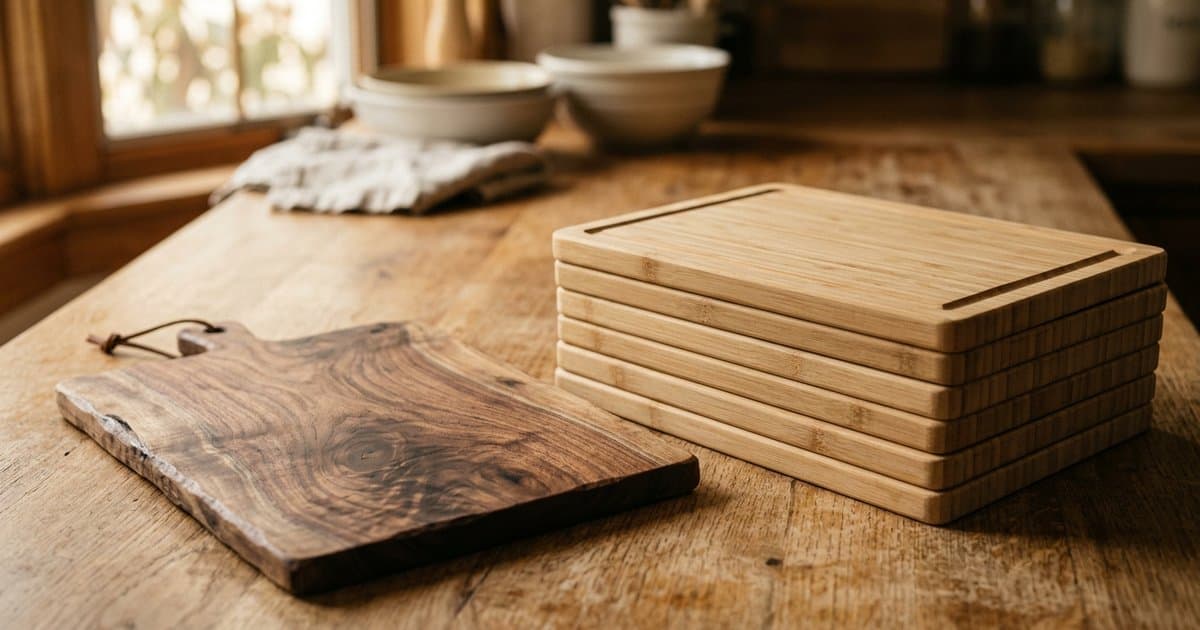
Walk into any big box store and you will find an aisle full of wooden kitchen products. Cutting boards, serving trays, utensil holders, all priced low enough to seem like a good deal. They look fine in the package. But pull one off the shelf, run your hand across the surface, and feel the rough grain, the lightweight construction, the edges that were never quite smoothed down. That is what mass production delivers. It is not bad, exactly. It is just adequate.
At our workshop in Jacksonville, FL, we take a different approach. Every piece we build is part of a small batch, usually no more than a dozen at a time. That might sound inefficient, and by factory standards it is. But inefficiency measured by volume looks very different when you measure by quality. Here is why small batch production creates a better product for your kitchen and your home.
Quality Control When Every Piece Gets Attention
In a factory producing thousands of units per day, quality control is a statistical exercise. A certain percentage of finished products are pulled from the line and inspected. If the defect rate stays below the target threshold, production continues. The boards that were not inspected go straight into boxes. Some are perfect. Some are not. The math says most of them are good enough, and for the factory, good enough is good enough.
In a small batch shop, quality control looks nothing like that. We inspect every single piece at multiple stages throughout the build. We check the raw lumber before we start cutting. We examine every glue joint after clamping. We run our hands across every surface after sanding. We look at the finish under natural light before we apply the final coat. If something does not meet our standard at any stage, we fix it or start over.
That level of attention is only possible when you are working in small quantities. A person can meaningfully inspect ten or twelve boards in a batch. A person cannot meaningfully inspect ten thousand. The math is simple, and it favors small batch production every time quality is the priority.
Material Selection Without Compromise
When a factory needs ten thousand board feet of walnut, they place a bulk order and take what arrives. They cannot afford to reject half the shipment because the grain is not quite right or the color is not consistent. The economics of mass production demand that you use what you get and keep the line moving.
Our material selection process is completely different. We hand-select every piece of lumber that comes into our shop. We look at grain direction, color consistency, moisture content, and structural integrity. A board with beautiful figure on one face might have a hidden crack on the other side. We find that before it becomes part of a cutting board, not after. Wood with inconsistent moisture gets set aside to acclimate rather than being pushed into production on a schedule dictated by output targets.
This selectivity means we reject a meaningful percentage of the lumber available to us. That increases our material cost per piece, but it also means that every finished product starts with wood that was chosen specifically for its quality. You can see the difference in the grain patterns, feel it in the weight and density, and experience it in how the piece performs over years of use.
The Pace That Craftsmanship Requires
Good woodworking cannot be rushed. Glue joints need time under pressure to cure fully. Finishes need time to absorb into the grain before the next coat is applied. Wood needs time to acclimate to the shop environment before it is cut and shaped. Rushing any of these steps produces a piece that looks finished but is not truly ready.
Mass production runs on tight schedules. Every minute a product spends in the factory is a cost. So glue-ups get shortened, finish coats get reduced, and acclimation periods get skipped. The product makes it through the process faster, but the shortcuts compound. A joint that was clamped for thirty minutes instead of overnight might hold for a year, but it is more likely to fail under the stress of daily kitchen use. A finish applied in a single coat instead of three will wear through sooner and leave the wood exposed to moisture and staining.
In our workshop, the schedule is dictated by the work itself. We do not rush glue-ups because we have a shipping deadline. We let the joints cure fully, sand when the wood is ready, and apply finish in the layers it needs. Some pieces spend several days in production even though the actual hands-on work might only be a few hours. That waiting time is not wasted. It is built into the process because the results demand it.
Consistency Through Intention, Not Uniformity
There is an important distinction between consistency and uniformity. Mass production delivers uniformity. Every piece looks the same because the machines that make them follow the same program regardless of the material. A knot in the wood, a change in grain direction, a variation in color. The machine does not notice and does not adjust.
Small batch production delivers consistency of quality without demanding uniformity of appearance. Every board we build meets the same standard for smoothness, structural integrity, and finish quality. But each one looks a little different because the wood itself is different. The grain pattern on your cutting board is unique. The color depth of the walnut in your serving tray is specific to that particular piece of lumber. Those variations are not defects. They are the natural character of real wood, and they are what make each piece genuinely one of a kind.
We lean into those natural variations rather than fighting them. When we lay out pieces for a cutting board or serving tray, we arrange the wood to highlight the most beautiful grain patterns. A factory feeding boards through a machine does not have that option. The result is the difference between a product and a piece of craftsmanship.
Pride in the Work
This might be the hardest thing to quantify, but it might be the most important. When you build things in small batches, you develop a relationship with each piece. You remember the walnut board with the extraordinary figure that you set aside for a special project. You remember the maple that had such a tight, even grain that it sanded like butter. You remember the customer who asked for something specific and how you figured out the best way to build it.
That pride shows up in the finished product in ways that are hard to describe but easy to recognize. It is in the extra pass with fine sandpaper on an edge that was already smooth. It is in the second look at a glue line to make sure it is invisible. It is in the care taken to orient the grain so the piece looks its best on your counter. These are not steps in a manufacturing checklist. They are instincts that develop when you care about what you are building.
Factory workers are often skilled people doing their best within a system that does not reward extra care. The incentive structure in mass production favors speed and volume. In a small workshop, the incentive structure is completely reversed. Our reputation is built one piece at a time, and every piece that leaves our shop either strengthens or weakens that reputation. That changes how you approach the work.
The Real Cost Comparison
Small batch products cost more than mass-produced ones. That is an honest fact, and we do not try to hide it. But cost and value are different things, and the value calculation favors small batch production in ways that the price tag does not immediately reflect.
A mass-produced cutting board might cost twenty dollars and last two years before it warps, cracks, or becomes too scarred to use hygienically. Over a decade, you will buy five of them, spending a hundred dollars total and sending four worn-out boards to the landfill. A well-made small batch board costs more up front but lasts ten, fifteen, even twenty years with basic care. The per-year cost is lower, the experience is better, and the environmental impact is a fraction of the disposable alternative.
There is also the intangible value of owning something that was made with genuine care. A cutting board that you know was built by a real person in a real workshop carries a different weight in your kitchen than something stamped out by the thousand. It is a piece you keep, maintain, and eventually pass along. You do not throw it away and buy another one when the next model comes out. That kind of lasting satisfaction has real value, even if it does not show up on a spreadsheet.
What Small Batch Means at Schmidt Woodcraft
For us, small batch means that we build in quantities that allow us to maintain complete control over quality. A typical production run in our Jacksonville workshop is six to twelve pieces of the same design. That is large enough to work efficiently with our materials and small enough that every piece gets individual attention from start to finish.
It means we know the history of every board we sell. We can tell you what species the wood is, where it was sourced, how long it acclimated in our shop, and what finish was applied. That traceability is something mass production cannot offer, and it is part of what gives our customers confidence in what they are buying.
It also means we can respond to what our customers want. If someone requests a specific wood combination or a non-standard size, we can accommodate that in our next batch. A factory retooling for a single custom request does not make economic sense. For us, it is just part of how we work. You can submit a custom order request any time, and we will work with you to build exactly what you are looking for.
Choose What Lasts
The next time you are shopping for something for your kitchen, take a moment to consider where it came from. Was it made by someone who inspected every surface and chose every piece of wood with intention? Or was it one of ten thousand identical units that rolled off a line and into a box without anyone looking twice?
The answer to that question will show up in how the product feels in your hand, how it performs on your counter, and how long it lasts in your kitchen. We believe small batch is better because we see the results every day in our workshop and hear it from customers who have been using our pieces for years.
If you are ready to experience the difference, explore our collection and bring something into your kitchen that was built with the care it deserves.
Looking for the perfect cutting board?
Every board we make is built by hand in our Jacksonville, FL workshop using premium hardwoods. Browse our collection or request a custom piece.