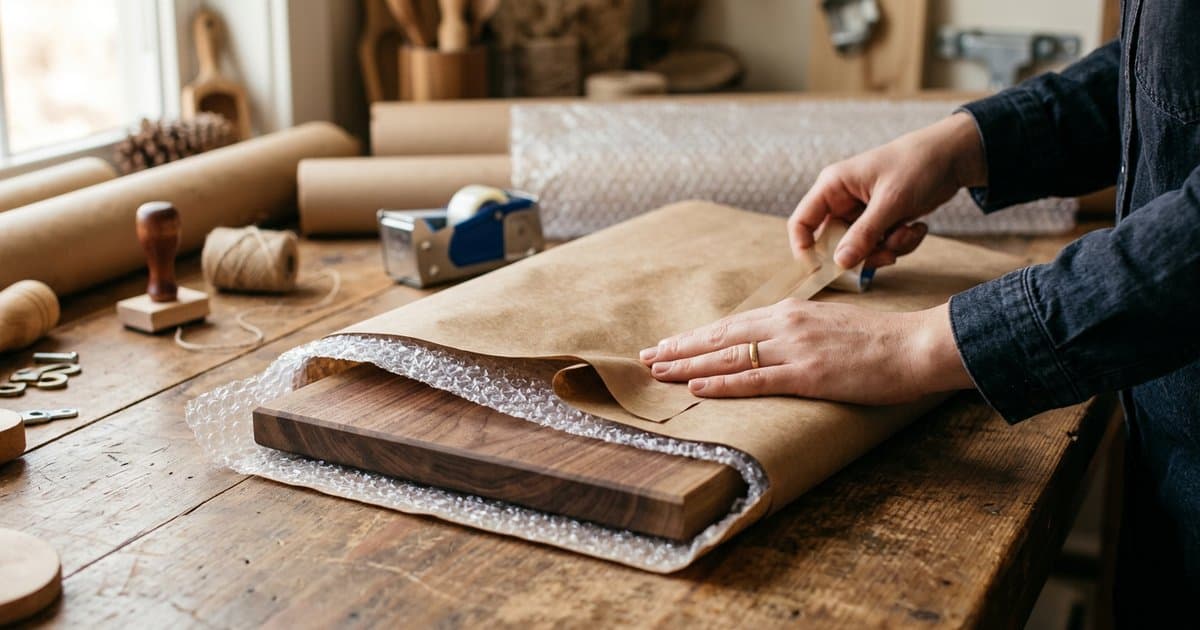
We spend a lot of time building things the right way. Selecting the right hardwood, gluing joints that will hold for decades, sanding surfaces until they feel like glass under your fingers. So the last thing we want is for all of that care to be undone in the back of a delivery truck somewhere between Jacksonville and your front door.
Shipping handmade wooden products is not the same as shipping a book or a t-shirt. Wood is dense, rigid, and sensitive to impact. A cutting board that weighs three pounds can build serious momentum during a drop, and the corners are especially vulnerable. We have spent years refining our shipping process to make sure that what arrives at your kitchen looks and feels exactly the way it did when it left our workshop.
Why Shipping Wood Takes Extra Care
Wood is a beautiful material, but it has characteristics that make shipping tricky. Unlike plastic or metal, wood can crack or chip on impact, especially along the end grain or at sharp corners. A solid walnut cutting board is strong enough to handle years of heavy knife work, but a four-foot drop onto a concrete loading dock can chip an edge or crack a glue joint if the piece is not properly protected.
There is also the issue of moisture. Wood naturally absorbs and releases moisture depending on the environment. A board that leaves our Jacksonville workshop in Florida's humidity and travels to a dry climate in the Southwest will experience some adjustment. While we finish every piece to slow that process down, the packaging still needs to protect the wood during the transition. Wrapping a board in plastic and sealing it tight might seem like a good idea, but it can actually trap condensation and cause problems. We use materials that protect without suffocating the wood.
Understanding these realities is the first step. The second step is building a packaging process that accounts for every one of them.
Our Packaging Process Step by Step
Every piece that ships from our workshop goes through the same careful packaging routine, whether it is a small coaster set or a large end grain cutting board.
First, we give the piece a final inspection. We check every surface, every edge, every corner. We look for any imperfections that might have appeared during the finishing process. If something is not right, it goes back to the bench. We do not package anything we are not completely satisfied with.
Next, we wrap the piece in soft, food-safe tissue paper. This creates a gentle barrier against scuffs and keeps the oiled surface clean during transit. For pieces with especially fine finishes, we add a layer of foam sheeting that conforms to the shape of the board without pressing against the surface.
Then comes the corrugated cardboard. We use double-walled corrugated boxes for anything over two pounds. Single-wall cardboard is fine for a paperback novel, but it does not offer enough crush resistance for dense hardwood. The double-wall construction gives us the rigidity we need to protect against stacking pressure and side impacts.
Finally, we fill the remaining space in the box with kraft paper packing material. We avoid packing peanuts because they shift during transit, leaving the product unsupported after a few bumps. Kraft paper stays put and provides consistent cushioning on all sides. Each piece is snug inside the box with no room to shift or rattle.
Corner and Edge Protection
The most vulnerable parts of any wooden product are the corners and edges. A cutting board can survive a flat drop with minimal risk, but a corner-first impact concentrates all the force on a tiny area. That is where chips and cracks happen.
For our larger boards and serving trays, we use foam corner protectors that absorb shock at the most exposed points. These are the same type of protectors used for shipping furniture and framed artwork. They add a small amount of weight to the package, but the protection they provide is worth it.
We also pay attention to edge protection along the long sides of rectangular boards. A layer of foam sheeting runs along each edge inside the wrapping, creating a buffer between the wood and the box wall. Even if the box takes a hit from the side, the foam absorbs the energy before it reaches the wood.
Materials We Use and Why
We have tested a lot of packaging materials over the years. Some looked promising but did not hold up in practice. Here is what we have settled on and why each material earns its place in our process.
Food-safe tissue paper is our first layer. Since our products go directly into contact with food, we want the wrapping material to be clean and non-toxic. Standard tissue paper can leave lint or chemical residues that do not belong on a cutting surface.
Closed-cell foam sheeting provides impact absorption without absorbing moisture. Open-cell foam, the spongy kind, can hold water and create exactly the kind of damp environment we want to avoid. Closed-cell foam is moisture resistant and provides a firm cushion that does not compress flat over time.
Double-walled corrugated boxes give us structural integrity. We source boxes that are close to the right size for each product category so we are not filling a massive box with packing material. A snug fit means less room for the product to move and less wasted material.
Kraft paper packing material fills the remaining gaps. It is recyclable, compostable, and does a better job than plastic alternatives at staying in position during transit. When you open your package, everything inside goes straight into your recycling bin or compost.
Shipping Timeline from Jacksonville
Our workshop is in Jacksonville, FL, which puts us in a strong position for shipping to the eastern half of the country. Most orders to the East Coast and Midwest arrive within three to five business days using standard ground shipping. West Coast deliveries typically take five to seven business days.
We process and ship most orders within one to two business days of receiving them. During busy seasons, especially around the holidays, that processing time can stretch to three or four days as we work through a higher volume of orders. We always communicate expected timelines clearly, and you will receive tracking information as soon as your order ships.
For customers here in the Jacksonville area, we also offer local pickup from our workshop. That eliminates shipping concerns entirely and lets you see the piece in person before you take it home. It is one of the perks of buying from a local maker.
How We Handle the Rare Problem
Despite all the care we put into packaging, the reality of shipping is that things occasionally go wrong. A box gets dropped, stacked improperly, or left in the rain. It does not happen often, but we plan for it.
If your order arrives with any damage, we want to hear about it immediately. We ask for a few photos of the damage and the packaging so we can understand what happened and improve our process. Then we make it right. That might mean sending a replacement, refinishing the piece, or working with you to find the best solution. We do not argue about it or make you jump through hoops. The piece left our shop in perfect condition, and if it did not arrive that way, that is our responsibility to fix.
This commitment to standing behind our work is part of what separates buying from a small workshop and buying from a faceless retailer. We care about every piece, and we care about your experience from the moment you place your order to the moment you put that board on your counter.
Sustainability in Our Shipping
We think about the environmental impact of our packaging as well. Everything we use is either recyclable or compostable. We do not use plastic wrap, styrofoam, or non-recyclable materials. The kraft paper, tissue paper, and corrugated cardboard can all go into your curbside recycling. The foam sheeting is reusable if you want to save it.
We also right-size our boxes wherever possible. Shipping air is wasteful. A box that is too large requires more packing material, costs more to ship, and takes up more space on the truck. By keeping our box sizes close to the product dimensions, we reduce waste, lower shipping costs, and decrease the carbon footprint of every delivery.
It is a small thing in the grand scheme, but it lines up with how we think about everything in our workshop. Do it right, waste as little as possible, and take pride in the details.
From Our Hands to Yours
Every piece that ships from Schmidt Woodcraft was built by hand in our Jacksonville workshop from carefully selected hardwoods. We put the same intention into packaging that piece as we put into building it. When you open the box and unwrap your new cutting board or serving tray, we want that moment to feel right. Clean, beautiful, and ready for your kitchen.
If you are ready to bring a handmade piece into your home, browse our collection and find something that speaks to you. And if you have a specific vision in mind, reach out about a custom order. We will build it with the same care and ship it with the same attention to detail that goes into everything we do.
Looking for the perfect cutting board?
Every board we make is built by hand in our Jacksonville, FL workshop using premium hardwoods. Browse our collection or request a custom piece.