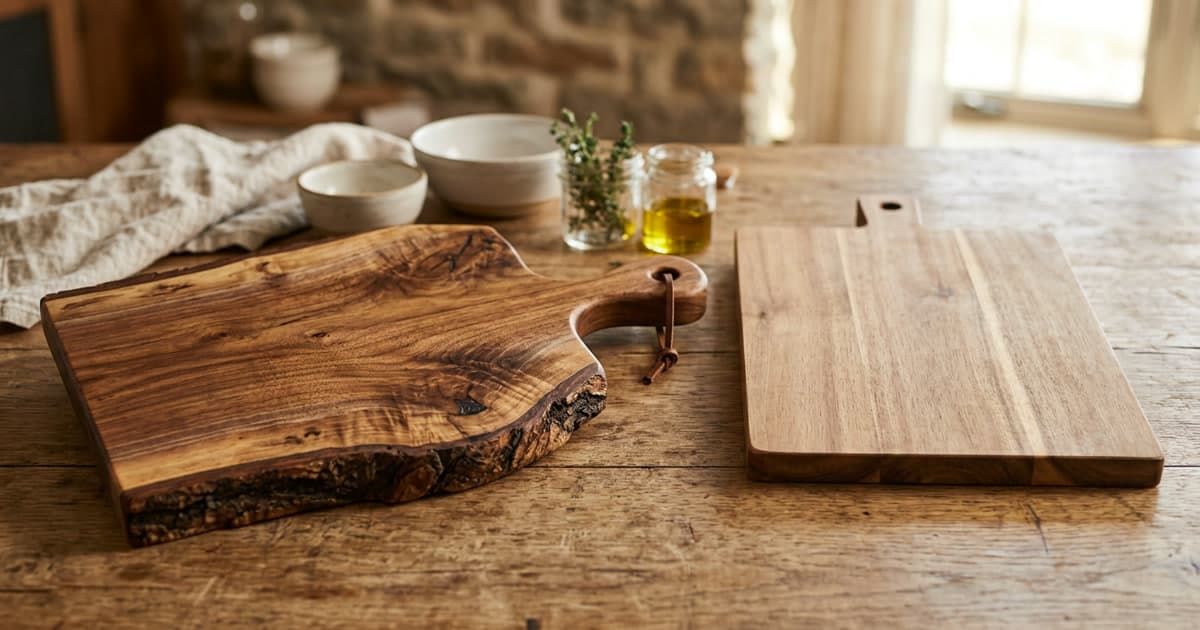
There is a familiar routine. You need a cutting board, a serving tray, or a gift for someone who matters. You browse online or walk through a store, and you find something that is close. Close to the right size, close to the right look, close to what you had in mind. You buy it because it is available and the price seems reasonable. And it works. For a while.
Custom woodwork asks you to take a different approach. Instead of settling for close, you describe exactly what you want, and someone builds it. The result is a piece that fits your life precisely, made from materials that will last, with a level of quality that mass production simply cannot match. Here is why custom beats off-the-shelf every time, and why the difference matters more than you might expect.
Perfect Fit, Not Close Enough
Off-the-shelf products are designed for the average customer, and no customer is average. Your kitchen counter is a specific width. Your island has a specific amount of space. The spot next to your stove where you want a cutting board to live has exact dimensions that a product designer in a factory has never considered.
When you order a custom piece, those dimensions are the starting point. We build to the size that works for your space, not the size that fits the most shipping boxes. A cutting board that sits perfectly on your counter, neither too large to be unwieldy nor too small to be useful, changes how you interact with it. You reach for it more often because it just works in your kitchen.
Fit is not only about dimensions either. It is about how a piece works within the context of your home. The wood species can be chosen to complement your cabinetry. The thickness can be calibrated for how you cook. The shape can be tailored to how you like to present food when guests come over. These are details that a factory cannot account for, but a custom maker can.
Materials That Actually Matter
Walk through the kitchen section of any big-box store and read the labels on the cutting boards. You will see bamboo, acacia, rubberwood, and an assortment of vague descriptors like "premium hardwood" that do not tell you much about what you are actually buying. These materials are chosen for their price point, not for their performance in your kitchen.
Custom woodwork starts with a different set of priorities. When we select wood for a custom project, we are thinking about density, grain structure, workability, food safety, and beauty. Hard maple is one of the densest domestic hardwoods and naturally resists bacteria. Walnut brings rich color and excellent durability. Cherry offers warmth that deepens over years of use. Each species has been proven in kitchens for generations.
Beyond species selection, we choose individual boards of lumber based on their specific character. We look at grain direction, color consistency, moisture content, and the absence of defects. A factory buying lumber by the truckload does not have the ability to inspect every piece this way. We do, because each project matters individually.
The finish is another area where materials diverge. Our food-safe mineral oil and beeswax blend is applied by hand in multiple coats, with time between each coat for proper absorption. Many factory boards receive a single machine-applied coat of mineral oil, if they receive any finish at all. The difference shows up in how the wood feels, how it resists moisture, and how it ages over time.
Quality You Can Feel
Pick up a mass-produced cutting board and run your hand along the edge. Then pick up a handmade one. The difference is immediate and unmistakable. The handmade board has edges that have been rounded and smoothed by hand, creating a profile that feels natural and comfortable when you grip it. The surfaces have been sanded through progressively finer grits until they feel like silk. The corners are softened so they do not catch on dish towels or scratch your countertop.
These are not cosmetic details. A board with sharp edges is uncomfortable to carry to the table. A board with a rough surface stains more easily and is harder to clean. A board with poorly finished corners chips and splinters with use. The quality you feel in a handmade piece translates directly to how it performs and how long it lasts.
Then there is the joinery. In a handmade board, every glue joint is assembled with waterproof, food-safe adhesive and clamped under pressure for hours. The joints are invisible, flush, and permanent. In a factory board, joints are clamped briefly and sometimes visibly imperfect. Over months of use and washing, weak joints begin to separate. A seam opens. Water gets in. The board warps, splits, and eventually ends up in the trash.
Something That Means Something
An off-the-shelf cutting board is a commodity. It has no particular connection to you, your family, or the occasion it was purchased for. A custom piece is fundamentally different. It was designed with you in mind, built for your specific purpose, and often carries a personal element like an engraved name, date, or message that ties it to a moment in your life.
This personal dimension is especially significant when the piece is a gift. We see this every week in our workshop. A customer ordering a wedding gift is not just buying a board. They are investing in something that represents their relationship with the couple, something that will live in the couple's kitchen and carry that meaning forward for decades.
Even when a custom piece is not a gift, there is a personal satisfaction in owning something that was made for you by a specific person in a specific place. You know where it came from. You know the wood it is made of. You know the care that went into building it. That knowledge changes your relationship with the object in a way that a barcode and a generic product description never will.
Supporting Real People
When you buy an off-the-shelf product from a large retailer, your money enters a system so vast and distributed that it is impossible to know where it ends up. Some fraction goes to the factory workers who made the product. Some fraction goes to the shipping companies that transported it. Most of it goes to corporate overhead, marketing, and shareholder returns.
When you buy from an independent maker, the equation is simple and direct. Your purchase supports a real person doing work they care about, in a community you can point to on a map. For us, that community is Jacksonville, Florida. Your order pays for the lumber we source, the tools we maintain, the workshop we operate, and the livelihood of the people who do this work every day.
There is a ripple effect too. We buy our hardwoods from suppliers who prioritize responsible forestry. We use local services for shipping supplies and equipment maintenance. The money you spend on a custom piece circulates through a local economy rather than disappearing into a global supply chain. That is not a minor distinction. It is a fundamentally different way of participating in the economy.
Long-Term Value
The sticker price of a custom piece is higher than the sticker price of an off-the-shelf alternative. That is undeniable. But price and value are different things, and the value calculation changes dramatically when you factor in how long each piece lasts.
A well-made custom cutting board, properly maintained, will last fifteen to twenty-five years or more. A typical mass-produced board lasts two to four years before it warps, cracks, or develops joints that no longer hold. Over a twenty-year span, you might buy one custom board or six to ten factory boards. When you add up the cost of all those replacements, the custom piece is often less expensive in the long run.
There is also the value of consistency. When your board lasts two decades, you are not shopping for a replacement every couple of years. You are not breaking in a new surface, adjusting to a new size, or dealing with the disappointment of a product that fails sooner than it should. You just have your board, the one that fits your kitchen and your routine, and you use it without thinking about it. That consistency has real value in a daily routine.
Then consider what happens at the end. A mass-produced board that cracks and warps goes in the trash. A custom hardwood board that reaches the end of a very long service life can be refinished and given new life, or it biodegrades naturally because it is made from solid wood with food-safe finishes and no synthetic fillers. Even at the end of the road, the custom piece is the better option.
The Experience Itself
Buying something off a shelf takes thirty seconds. Commissioning a custom piece takes a few weeks. But those few weeks include a conversation about what you want, a collaborative design process, the anticipation of watching your piece take shape, and the satisfaction of receiving something that was built just for you. The experience itself is part of the value.
We hear this from customers regularly. They tell us that the process of commissioning their piece was enjoyable. They liked choosing the wood, approving the engraving design, and receiving progress photos from the workshop. They felt involved in the creation of something meaningful, and that involvement made the finished product resonate on a deeper level than anything they could have picked up in a store.
You can read more about what that process looks like step by step in our guide to ordering a custom cutting board. It is more straightforward than most people imagine, and the results speak for themselves.
Ready to Go Custom?
If you have been settling for close enough, you do not have to anymore. A custom piece built from premium hardwood, designed for your specific needs, and crafted by hand in our Jacksonville workshop is within reach. Whether you need a kitchen workhorse, a stunning serving piece, or a gift that will be remembered for years, custom is the way to get exactly what you want.
Start your custom order today, and discover what it feels like to own something that was made for you.
Looking for the perfect cutting board?
Every board we make is built by hand in our Jacksonville, FL workshop using premium hardwoods. Browse our collection or request a custom piece.