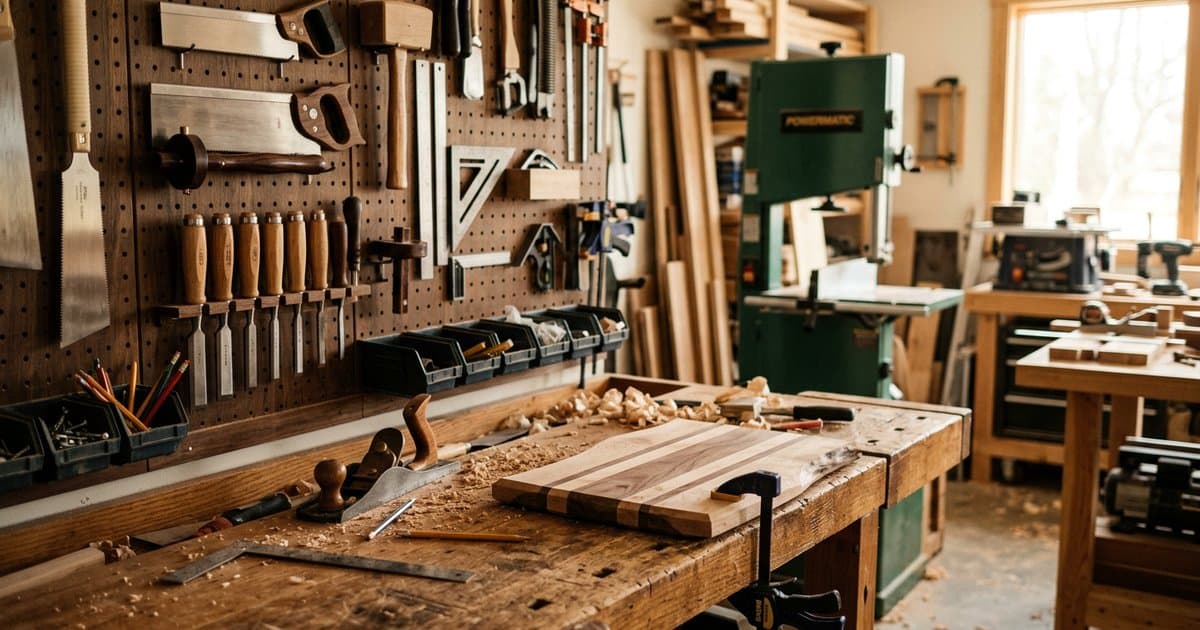
When you hold one of our cutting boards for the first time, you feel the weight and the smoothness and the warmth of the wood. What you probably do not think about is the hours of work that went into getting it to that point. Every piece that leaves our Jacksonville workshop goes through a careful process, and each step matters. We thought it would be worth pulling back the curtain and showing you what a typical day looks like for us.
Fair warning: this is not glamorous work. It is dusty, physical, and requires a lot of patience. But it is deeply satisfying, and the results speak for themselves.
Morning: Planning and Wood Selection
Most days start with coffee and a look at what is on the schedule. We review current orders, check on pieces that are in progress, and plan out what needs to happen that day. Woodworking is a process with a lot of waiting built in, mostly for glue to cure and finishes to dry, so sequencing the work correctly is important.
Once we know the plan, we head to the wood rack. This is one of the most important steps in the entire process, and it is easy to underestimate. Selecting the right boards for a project is not as simple as grabbing whatever is on top of the pile. We are looking at grain direction, color consistency, moisture content, and any defects that need to be worked around.
For a walnut cutting board, we might sort through a dozen boards to find the right combination of heartwood and sapwood. For a maple board, we are looking for tight, consistent grain that will produce a clean, uniform surface. Every species has its own personality, and learning to read the wood is a skill that takes years to develop.
Milling and Dimensioning
Once the lumber is selected, it needs to be milled to precise dimensions. Raw lumber, even kiln-dried stock from reputable suppliers, is never perfectly flat or straight. Our first task is to joint one face flat, plane the board to a consistent thickness, and rip it to the widths we need.
This stage is loud, dusty, and requires full attention. The jointer and planer are powerful tools that demand respect. Rushing through this step is a good way to ruin an expensive piece of hardwood or, worse, injure yourself. We take our time, check measurements frequently, and make sure every piece is dead flat and square before moving on.
For edge grain boards, we rip the lumber into strips and arrange them so the grain patterns complement each other. For end grain boards, which you can see in our product collection, the process is more involved. The strips get glued into a slab first, then crosscut and rearranged to expose the end grain. It is essentially building the board twice.
Glue-Up: Patience Required
Gluing is where the individual strips become a single, solid board. We apply food-safe wood glue to each joint, align the strips carefully, and clamp everything together under heavy pressure. The alignment has to be precise. Even a small offset between strips creates extra work during sanding and can weaken the final product.
Once the clamps are on, we walk away. Glue needs time to cure properly, and there is no shortcut. We typically let panels sit in clamps for at least a few hours, sometimes overnight for larger pieces. Rushing this step risks joint failure down the road, which is something we refuse to accept.
While panels are curing, we use the downtime to work on other projects, prepare materials for the next batch, or handle the business side of things. Answering customer inquiries, updating the website, packaging orders for shipping. Running a small workshop means wearing a lot of hats.
Shaping and Detailing
Once the glue has fully cured, we remove the clamps and start shaping the panel into its final form. This means trimming the board to size, routing the edges to the desired profile, and adding any features like juice grooves, finger grips, or handles.
Edge profiling is a subtle detail that makes a big difference in how a board feels. A simple roundover makes the edges comfortable to grip. A chamfer gives a more modern, angular look. We choose the profile based on the style of the piece and how it is going to be used.
Juice grooves, which are the channels routed around the perimeter of some cutting boards, require a steady hand and careful setup. The groove needs to be deep enough to catch liquid but not so deep that it weakens the board or becomes hard to clean. Getting that balance right is something we have refined through building hundreds of boards.
Sanding: Where Good Becomes Great
Sanding is the step that separates a decent board from a great one. It is also the step that takes the most patience. We sand every surface through a progression of grits, starting coarse to remove any tool marks or glue residue and working our way up to a fine, smooth finish.
Between grits, we raise the grain by wiping the surface with a damp cloth. This causes any loose wood fibers to stand up so they can be knocked back down with the next pass. It is an extra step that many production shops skip, but it makes a real difference in the final feel of the surface.
By the time we reach the final grit, the board should feel like silk under your hand. No rough spots, no scratches, no raised fibers. Running your fingers across the surface should feel effortless. If it does not, we keep sanding. There is no grit number where we automatically stop. We stop when it feels right.
Finishing: Bringing the Wood to Life
Finishing is the most visually dramatic step. When we apply the first coat of food-safe mineral oil to a freshly sanded board, the grain explodes with color and depth. Walnut goes from a muted brown to a rich, deep chocolate. Cherry warms up with reddish-gold tones. Maple takes on a subtle, creamy glow. It is one of the most rewarding moments in the entire process.
We use food-safe mineral oil and beeswax-based board cream for our finishes. These products are safe for contact with food, easy to maintain, and they enhance the natural beauty of the wood without creating a plastic-like coating. The oil soaks into the grain, hydrating the wood and creating a barrier against moisture. The wax adds a soft sheen and an extra layer of protection.
We apply multiple coats, allowing each one to soak in before adding the next. The wood will tell you when it has had enough. Once it stops absorbing oil and the surface has an even, consistent sheen, the board is ready. If you want to know how to maintain that finish at home, our care guide covers everything you need.
Final Inspection and Quality Control
Before any piece leaves the workshop, it goes through a final inspection. We check every surface, every edge, every corner. We look for any sanding scratches we might have missed, any glue squeeze-out that was not fully cleaned up, any inconsistencies in the finish.
We also check the board's function. Is it flat? Does it sit stable on a counter without rocking? Are the proportions right for its intended use? Does the juice groove channel liquid properly? These are not cosmetic concerns. They affect how the board performs in a real kitchen every day.
If something does not pass inspection, we fix it. Sometimes that means going back to the sanding stage. Occasionally, if a defect is structural, it means starting over. That is the cost of holding a high standard, and it is a cost we are always willing to pay. Our name is on every piece, and we want each one to represent our best work.
The Reward of Handmade
At the end of a day in the workshop, the floor is covered in shavings and sawdust, our arms are tired, and there is fine wood dust in places we would rather not mention. But there is usually a stack of finished pieces on the bench that were not there that morning, and each one is something we are genuinely proud of.
That pride is what drives the whole operation. Every board, every tray, every piece we build carries the accumulated effort of a full day's work by someone who cares deeply about getting it right. That is the difference between handmade and manufactured, and it is a difference you can feel the moment you pick up one of our pieces.
Want to see what comes out of all this effort? Browse our current collection or reach out about a custom piece built to your exact specifications. We would love to put this process to work for you.
Looking for the perfect cutting board?
Every board we make is built by hand in our Jacksonville, FL workshop using premium hardwoods. Browse our collection or request a custom piece.